TL;DR:
- Many indie founders are now acquiring profitable SaaS businesses to skip lengthy product development processes and achieve instant cash flow. Acquiring small, AI-powered SaaS tools under $100k offers fast, capital-efficient returns, especially through multiple arbitrage. Success depends on active post-sale management, thorough due diligence, and leveraging AI’s automation advantages to build scalable, valuable portfolios.
Most founders assume the only path to SaaS success is building from scratch, grinding through months of product development, failed launches, and the slow burn of finding product-market fit. That assumption is costing you time and money. A growing wave of indie founders and tech entrepreneurs is quietly skipping that entire phase by acquiring small, profitable SaaS businesses that already generate recurring revenue. This guide breaks down why buying cashflowing SaaS, especially AI-powered tools under $100k, is one of the most capital-efficient moves available in 2026, and exactly what you need to know to do it right.
Table of Contents
- Why entrepreneurs are turning to cashflowing SaaS acquisitions
- What makes cashflowing SaaS under $100k so attractive?
- How AI-powered SaaS changes the acquisition game
- Risk, churn, and what to watch when buying SaaS in 2026
- What most guides miss about buying cashflowing SaaS
- Ready to find your next cashflowing SaaS?
- Frequently asked questions
Key Takeaways
| Point | Details |
|---|---|
| Faster time to cashflow | Acquiring SaaS bypasses the months or years needed to achieve product-market fit and early growth. |
| Profit multiples advantage | Buyers can secure SaaS businesses at low 2-3x revenue, creating higher upside on exit. |
| AI SaaS supercharges returns | AI-powered SaaS automates processes and helps portfolios self-fund further growth. |
| Watch churn and risk | Thoroughly vet churn and technical health using 2026 SaaS benchmarks before acquiring. |
Why entrepreneurs are turning to cashflowing SaaS acquisitions
The shift from building to buying is not a new concept in private equity, but it has only recently become accessible to individual founders. Lower deal sizes, better marketplaces, and a surge in indie developers selling their side projects have created a genuine window of opportunity for buyers who move fast.
When you build a SaaS product, you are essentially betting on your ability to find customers who want what you are making before your runway runs out. Most products fail at that stage. Acquisition skips that entire gamble. As one SaaS acquisition framework puts it, buying an existing business skips product-market fit risk entirely and delivers instant cashflow from day one. That is not a small advantage. That is the difference between months of uncertainty and a business that pays you on the first of the month.
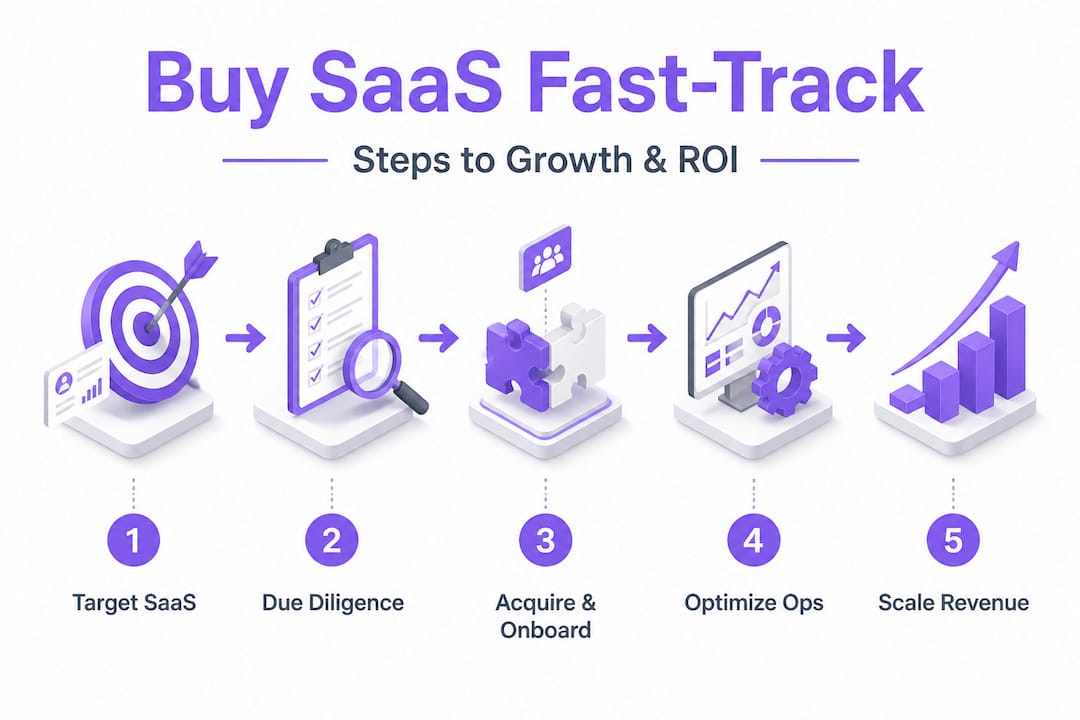
There is also a financial structure here that rewards smart buyers. Most micro-SaaS deals are priced at 2 to 3x annual revenue. But portfolio exits, where you bundle several of these businesses together, often command 8 to 15x multiples. That gap is called multiple arbitrage, and it is one of the core reasons SaaS acquisition versus building is becoming the preferred strategy for capital-efficient founders.
Here is what is driving the trend:
- Instant cashflow from a paying customer base on day one
- No PMF risk since the product already has proven demand
- Lower capital requirement compared to funding a build from scratch
- Faster path to portfolio by stacking multiple small acquisitions
- Downmarket access to deals that large funds ignore but individuals can win
“Acquisition skips PMF risk, provides instant cashflow for indie founders, and rollups create 2 to 3x multiple arbitrage, buying at 2 to 3x revenue and exiting a portfolio at 8 to 15x.”
You can read more about real AI SaaS growth stories from founders who have taken this exact path and built meaningful revenue without writing a single line of product code.
What makes cashflowing SaaS under $100k so attractive?
Understanding the motivations, let’s break down why sub-$100k SaaS deals offer such compelling advantages compared to larger acquisitions or building from scratch.
The most obvious appeal is the entry price. A SaaS for modern businesses generating $3,000 to $5,000 in monthly recurring revenue (MRR) might sell for $30,000 to $60,000 at a 2 to 3x annual revenue multiple. That is a deal size most individuals can fund without institutional backing, a loan syndicate, or a venture partner. You write the check, you own the business.
The ROI on a $10k purchase can be remarkable at this level. One documented case showed a buyer scaling a $10,000 acquisition to $22,000 in annual recurring revenue (ARR) while managing it in under 5 hours per week. That kind of return is hard to find in any other asset class at that price point.

Here is how micro-SaaS deal economics compare to larger acquisitions:
| Deal size | Typical multiple | Management time | Time to ROI |
|---|---|---|---|
| Under $50k | 2 to 3x annual revenue | 2 to 5 hrs/week | 12 to 18 months |
| $50k to $100k | 3 to 4x annual revenue | 5 to 10 hrs/week | 18 to 30 months |
| $100k to $500k | 4 to 6x annual revenue | 10 to 20 hrs/week | 24 to 36 months |
| Over $500k | 6 to 10x annual revenue | Full-time team | 36 to 60 months |
The pattern is clear. Smaller deals offer faster payback periods, lower management overhead, and more room for a solo operator to add value without hiring a team. Operational simplicity is a real feature at this level, not just a talking point.
Statistic callout: A $10,000 acquisition scaled to $22,000 ARR with less than 5 hours of weekly management time. At a 3x multiple, that same business could exit for $66,000, representing a 560% return on the original investment.
Pro Tip: At the sub-$100k level, due diligence on churn rate and tech stack quality matters more than at larger deal sizes. A leaky customer base or a fragile codebase can destroy your ROI faster than any market shift. Always pull at least 12 months of MRR data and review the underlying infrastructure before signing anything. Start your search by finding low-cost SaaS deals that match your criteria.
How AI-powered SaaS changes the acquisition game
Micro-acquisitions deliver solid returns, but AI supercharges their impact. Here is how.
Traditional SaaS businesses require ongoing human effort to deliver value: customer support, content creation, manual workflows, and constant feature updates. AI-powered SaaS tools automate a significant portion of that work. When you acquire an AI tool, you are buying a business that can often run with minimal human intervention, which directly expands your margin and reduces your time commitment.
The growth potential is also different. One documented case of an AI SEO tool showed a buyer scaling an acquired AI product to $58,000 in monthly recurring revenue within two years of acquisition. That is not a fluke. AI tools benefit from compounding usage patterns, network effects in data, and a market that is still in early adoption. Early acquirers are picking up tools before the broader market fully prices in their potential.
Here is how the ROI timeline compares between AI-powered and traditional SaaS acquisitions:
| Metric | AI-powered SaaS | Traditional SaaS |
|---|---|---|
| Automation level | High (70 to 90% automated) | Low to medium (30 to 60%) |
| Scaling cost | Near zero marginal cost | Linear with users |
| Time to $50k MRR | 12 to 24 months | 24 to 48 months |
| Management dependency | Low | Medium to high |
| Portfolio self-funding | Yes, within 6 to 12 months | Slower, 12 to 24 months |
The advantages unique to AI SaaS acquisitions include:
- Faster scaling because the core product improves with usage data, not just feature development
- Lower operational dependency since AI handles repetitive tasks that would otherwise require staff
- Recurring revenue models that compound over time as customers integrate the tool into their workflows
- Defensibility through proprietary training data and prompt engineering that competitors cannot easily replicate
- Portfolio self-funding where cashflow from one AI tool covers the acquisition cost of the next
You can explore the AI SaaS matching quiz to identify which category of AI tool aligns with your operational strengths and budget. The role of AI in business growth continues to accelerate, and buyers who position themselves in this space now are building portfolios with serious long-term leverage.
Risk, churn, and what to watch when buying SaaS in 2026
With the financial and technical opportunity defined, do not miss these risk markers and market metrics for 2026.
Buying a profitable SaaS is not a guaranteed win. The risks are real, they are specific, and they are manageable if you know what to look for. The biggest mistake new acquirers make is treating a SaaS acquisition like buying a rental property. It is not passive. It requires active attention, especially in the first 90 days.
2026 benchmarks to know:
According to current churn data, early-stage SaaS businesses show a median annual MRR growth rate of 84%, with monthly churn sitting around 4.7%. Top-quartile performers have monthly churn below 1%. If the business you are evaluating has monthly churn above 6%, that is a serious red flag that requires a clear explanation before you proceed.
CAC payback (the time it takes to recover the cost of acquiring a new customer) sits at a median of 12 months for healthy early-stage SaaS. If the seller cannot provide this data, that is itself a warning sign.
Here is a step-by-step framework for analyzing risk before you buy:
- Pull 12 months of MRR data. Look for consistent growth, not just a spike in the last 30 days before listing.
- Calculate net revenue retention (NRR). Healthy SaaS should show NRR above 100%, meaning existing customers expand their spending over time.
- Review the churn log. Ask for a list of every customer who canceled in the last 6 months and why they left.
- Audit the tech stack. Identify single points of failure, API dependencies, and any third-party tools that could change pricing or terms.
- Check documentation quality. Poorly documented code or processes signals a painful transition and higher operational risk post-acquisition.
- Evaluate support volume. High support ticket volume relative to user count suggests the product has usability problems that will consume your time.
Red flags that should make you pause or renegotiate:
- Monthly churn above 6% with no clear explanation
- Revenue concentrated in fewer than 5 customers
- No documentation for core workflows or codebase
- Automation that breaks frequently and requires manual fixes
- No post-sale support period offered by the seller
Pro Tip: Post-acquisition support from the seller is one of the most undervalued deal terms in small SaaS transactions. Always negotiate a 30 to 90 day transition period where the seller remains available for questions. This single clause can save you weeks of painful reverse-engineering. Review how SaaS deal fee structures work before you finalize any offer so there are no surprises at closing.
What most guides miss about buying cashflowing SaaS
Here is the part that most acquisition guides skip entirely, and it is the part that separates buyers who build real wealth from those who end up with a stagnant asset.
The numbers on a SaaS listing are a starting point, not a finish line. A business generating $2,000 MRR at acquisition can double in 18 months with the right operator, or it can slowly decay to zero with the wrong one. The difference is almost never the product. It is the buyer’s willingness to treat the acquisition as an active business, not a passive investment.
We see this pattern repeatedly. A buyer acquires a profitable tool, spends the first month learning the system, then coasts. They stop responding to support tickets promptly. They skip the one marketing channel that was driving growth. They delay a critical integration update. Six months later, churn has climbed and MRR is down 20%. The product did not fail. The operator disengaged.
The second thing most guides miss is exit planning. Most buyers at the sub-$100k level are thinking about cashflow, which is correct, but the real leverage comes from building toward a portfolio exit. Buying three or four complementary AI SaaS tools and packaging them as a cohesive portfolio can shift your exit multiple from 3x to 10x or higher. That is not theory. That is the same multiple arbitrage that private equity has used for decades, now available to individual founders.
Operational fit is also underweighted in most acquisition advice. A technically complex AI tool might look attractive on paper, but if your background is in marketing rather than engineering, you will struggle to maintain and improve it. The best acquisition is not the one with the highest MRR. It is the one where your specific skills create the most additional value post-close. Read deep-dive success stories from buyers who matched their background to the right deal type and scaled accordingly.
The uncomfortable truth is that buying SaaS is a skill, and the first acquisition teaches you more than any guide can. Go in with clear criteria, a realistic operational plan, and a 90-day post-acquisition roadmap before you sign anything.
Ready to find your next cashflowing SaaS?
If the frameworks in this guide have you thinking seriously about your first or next acquisition, the next step is finding deals that match your budget, skills, and growth goals.
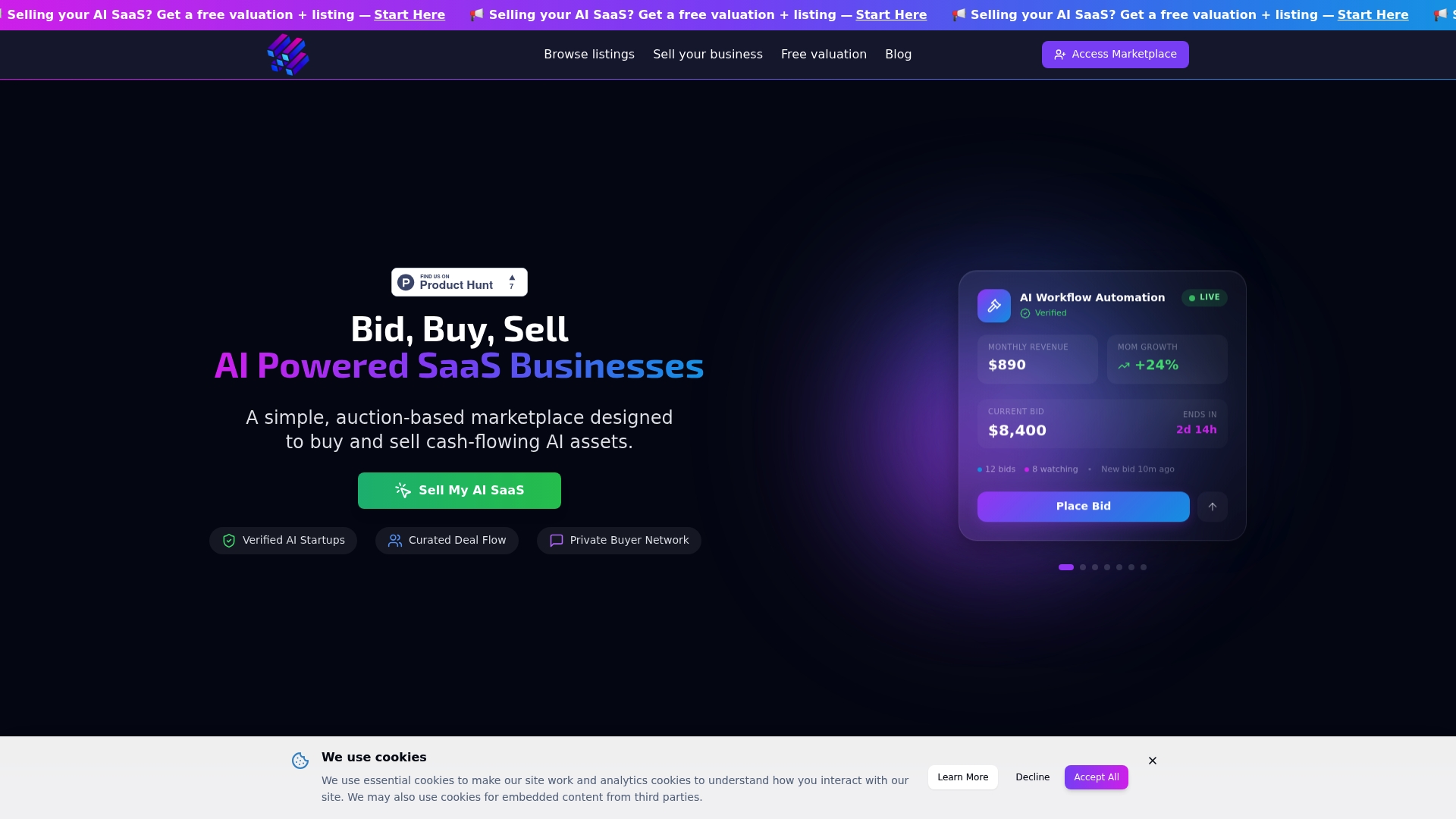
AIExchange.club is a curated marketplace built specifically for buying and selling AI-powered SaaS businesses. Browse active listings on the AI SaaS marketplace, take the buyer matching quiz to get matched with deals that fit your profile, and review the transparent pricing structure before you commit. There are no listing fees, no subscriptions, and no broker commissions. Just a flat 10% success fee when your deal closes. Most deals close in under 14 days, moving through a structured 6-stage pipeline from kickoff call to escrow. If you are ready to acquire a revenue-generating AI business without the six-figure minimums or broker overhead, this is where to start.
Frequently asked questions
How do I value a cashflowing SaaS under $100k?
Most profitable micro-SaaS businesses are valued at 2 to 3x annual revenue or 4 to 6x EBITDA, so thorough due diligence on cashflow consistency and growth trajectory is essential before making an offer.
What are typical churn and growth rates for early-stage SaaS in 2026?
Median annual MRR growth sits at 84%, with monthly churn around 4.7%; top-quartile businesses keep monthly churn below 1%, which is the benchmark serious buyers should target.
How fast can I earn back my investment from a cashflowing SaaS?
With typical 2 to 3x multiples, buyers who maintain or grow cashflow can recover their full investment within 24 to 36 months, often faster if the business scales post-acquisition.
Why focus on AI-powered SaaS for acquisition?
AI-powered micro-SaaS tools offer higher automation, faster scaling potential, and lower manual overhead than traditional SaaS, making them ideal for indie acquirers who want strong returns without building a full operations team.
What’s the biggest risk when buying a sub-$100k SaaS?
Unexpected customer churn and hidden technical debt are the top deal-killers; always review at least 12 months of churn metrics and benchmarks alongside a thorough code and documentation audit before closing.
Recommended
- Buy & Sell AI SaaS Businesses | AIExchange.club
- AI SaaS Acquisition Blog | AI Exchange Club
- Buy & Sell AI SaaS Businesses | AIExchange.club
- Buy & Sell AI SaaS Businesses | AIExchange.club
- SaaS Application Development Services | Meduzzen
Ready to make a move?
Whether you're looking to acquire your next AI SaaS or list your business for the right buyer, AI Exchange Club connects vetted buyers and sellers with a flat 10% success fee.

Comments (0)
Be the first to share your thoughts.