
TL;DR:
- Buying or selling an AI micro-SaaS business at auction requires disciplined evaluation based on verified metrics, margins, and growth models.
- Successful operators set clear bid limits, conduct thorough pre-auction research, and prepare detailed presentation materials to attract serious buyers or secure top offers.
Buying or selling an AI micro-SaaS business at auction is one of the fastest ways to create wealth in tech right now, but most founders leave serious money on the table by winging it. Acquisition criteria for high-performing AI micro-SaaS portfolios include $200K to $600K ARR, margins above 50%, low churn, and product-led growth, and the founders who internalize these benchmarks before the auction starts are the ones who consistently win. This article breaks down the exact strategies, frameworks, and post-acquisition playbooks that separate disciplined operators from expensive learners.
Table of Contents
- Essential criteria for evaluating AI SaaS auction opportunities
- Top AI SaaS auction strategies for buyers
- Key tactics for sellers in AI SaaS auctions
- Acquisition strategies: Post-auction playbooks for outsize returns
- Comparison: Buyer vs. seller strategies at a glance
- AI SaaS auctions: What most founders overlook
- Next steps: Buy and sell AI SaaS with confidence
- Frequently asked questions
Key Takeaways
| Point | Details |
|---|---|
| Use strict criteria | Focus on ARR, margins, and churn for auction decisions that build lasting portfolio value. |
| Strategize your auction play | Adopt proven buyer and seller tactics to maximize value and minimize risk in every auction. |
| Leverage post-acquisition optimization | Apply pricing audits, SEO, and AI upgrades to unlock rapid MRR growth after acquiring an asset. |
| Compare buyer and seller moves | Understand the distinct strategies and common mistakes on both sides of AI SaaS auctions. |
| Go beyond the sale | Build growth systems and track KPIs to compound returns well after the deal closes. |
Essential criteria for evaluating AI SaaS auction opportunities
Before you place a single bid, you need a checklist that cuts through the noise. Auction listings vary wildly in quality, and the pressure of a live bidding environment makes it dangerously easy to rationalize a bad deal. Solid evaluation criteria are your first line of defense.
The baseline metrics every serious buyer should verify are:
- Annual Recurring Revenue (ARR): Look for businesses in the $200K to $600K ARR range with consistent month-over-month growth, not a spike from a single viral moment.
- Profit margins: Anything below 50% net margin in a software business deserves heavy scrutiny. High margins signal operational efficiency and pricing power.
- Churn rate: Monthly churn above 3% to 5% is a red flag, especially for tools competing in crowded AI categories. Low churn proves the product actually solves a real problem.
- Growth model: Product-led growth (where the product itself drives acquisition and retention) is far more defensible than paid acquisition. If the business lives and dies by ad spend, factor that into your valuation.
- Revenue verification: Never take a seller’s word for it. Ask for Stripe or Paddle exports, connected analytics, and at least 12 months of transaction history.
Red flags to watch for in auction listings include sudden revenue spikes in the 60 to 90 days before listing, an unusually high percentage of annual plan customers (which can inflate ARR artificially), undisclosed API cost exposure, and vague answers about customer concentration. If one client represents more than 20% of revenue, that is a structural risk.
“A portfolio that grew to $120K MRR was built on rigorous selection criteria, not opportunistic buying. Every acquisition had to clear the margin, churn, and growth model bar before moving forward.” — from active AI SaaS portfolio operators
Pro Tip: Cross-reference the seller’s stated metrics against public signals like app store reviews, G2 ratings, and traffic data from tools like Semrush or Ahrefs. Discrepancies between public perception and reported numbers are worth investigating before you bid.
For deeper reading on what makes a strong acquisition target, the SaaS acquisition blog at AIExchange covers real deal breakdowns with annotated metrics.
Top AI SaaS auction strategies for buyers
With strong criteria locked in, the next challenge is execution. Knowing what to buy is only half the equation. Knowing how to win the right deal without overpaying, and then scaling it afterward, is where real returns are made.
1. Do your pre-auction homework before the clock starts. Request a seller interview at least a week before the auction opens. Ask about support burden, key integrations, and what the seller would do differently. The answers reveal operational complexity that no data room fully captures. Review the product yourself as a free trial user. This gives you a ground-level view of UX quality and feature gaps.
2. Set a walk-away number and stick to it. Calculate your maximum bid based on a realistic multiple of verified SDE (Seller’s Discretionary Earnings) or ARR, not on what you hope to grow it to. Auction environments trigger competitive psychology. Decide your ceiling before the bidding opens, write it down, and treat it as a hard limit.
3. Identify turnaround potential as a pricing advantage. Some of the best auction buys are businesses with obvious, fixable problems. An AI writing tool with strong retention but zero SEO presence is a pricing opportunity, not a liability. Post-acquisition results show that disciplined operators have achieved $58K MRR within two years of acquisition through targeted improvements like SEO, pricing restructuring, and AI feature upgrades.
4. Assess the AI infrastructure, not just the interface. Many AI tools are thin wrappers around OpenAI or Anthropic APIs with minimal proprietary logic. That is not necessarily bad, but it affects defensibility and margin. Tools with fine-tuned models, proprietary datasets, or deep workflow integrations are worth a premium. Pure wrappers with no moat need to be priced accordingly.
5. Plan your first 90 days before you close. Buyers who enter with a documented post-acquisition playbook move faster and make fewer expensive mistakes. Know which pricing tier you will audit first, which SEO pages you will build, and which integrations you will add. Preparation signals to sellers that you are a serious operator, which can also help in negotiation.
Pro Tip: Use a buyer matching quiz to filter for deals that match your operational strengths, budget, and growth thesis before browsing listings. Matching on fit beats browsing everything and hoping something sticks.
Understanding the fee structure guide before you make an offer also helps you model true acquisition cost accurately. A flat 10% success fee with no listing or subscription charges is materially different from broker-based models that layer on multiple costs.
Key tactics for sellers in AI SaaS auctions
Sellers face a different challenge. The goal is not just to find a buyer but to attract high-intent buyers who will bid competitively and close fast. How you present your business determines whether you get a strong offer or a lowball.
Presentation is everything in a curated marketplace. Build a clean data room before you list. This means organized financial statements, a product demo video, annotated analytics screenshots, and a written narrative that explains the AI roadmap. Buyers who can see the upside clearly will bid more aggressively. Buyers who have to dig for basic information will discount their offers to compensate for the uncertainty.
Key seller preparation steps include:
- Run a pricing audit before listing. Post-acquisition pricing audits are one of the highest-ROI moves for new owners, which means if you have already done it, you capture that value in your asking price rather than leaving it for the buyer.
- Document your product-led growth signals. Activation rates, feature adoption data, and NPS scores tell a story that raw revenue numbers cannot. Show buyers exactly what drives retention.
- Time your listing strategically. Listings that go live during periods of high AI industry momentum (major model releases, new enterprise AI adoption waves) tend to attract more attention and higher bids.
- Write a clear AI roadmap. Even a one-page document outlining three to five planned features or integrations signals that the product has a future, not just a history.
Stat callout: Active AI SaaS portfolios built through disciplined acquisition have reached $120K MRR across just three acquisitions, demonstrating that a well-presented, well-priced asset attracts the kind of buyer who compounds value fast.
Pro Tip: Before listing, read through the guide on selling your AI SaaS to understand exactly what buyers scrutinize and how to address objections before they arise in the bidding process.
Acquisition strategies: Post-auction playbooks for outsize returns
Winning the auction is the starting line, not the finish line. The operators who generate the best returns treat the first 90 days post-close as a structured sprint, not a discovery period.
Quick wins (Days 1 to 30): Start with a pricing audit. Most bootstrapped AI tools are underpriced relative to the value they deliver. A single tier adjustment or the addition of an annual plan option can lift MRR by 15% to 25% without acquiring a single new customer. Simultaneously, audit the top 10 organic search opportunities. Many indie-built tools have zero SEO infrastructure, which means even basic on-page optimization and a handful of targeted blog posts can generate compounding traffic within 60 to 90 days.

Mid-term upgrades (Days 31 to 90): This is when AI enhancements pay off. Add integrations with popular platforms (Zapier, Slack, Notion), upgrade the underlying model if a newer version improves output quality, and build out the feature set based on the most-requested items in support tickets. These moves improve retention, reduce churn, and create new upsell opportunities.
Optional spinoffs and secondary exits: If the product has a feature set broad enough to serve multiple niches, consider carving out a vertical-specific version. A general AI writing tool can spawn a legal brief writer or a real estate listing generator. Each vertical version can be listed as a separate asset on a marketplace like AIExchange for a secondary exit, creating a self-funding flywheel.
Empirical benchmarks confirm that acquisitions executed with disciplined playbooks yield 2x to 4x MRR growth, with portfolio cashflow funding subsequent acquisitions without outside capital.
| Metric | Pre-acquisition | Post-acquisition (12 months) |
|---|---|---|
| MRR | $8,000 | $18,000 to $24,000 |
| Net margin | 45% | 58% to 65% |
| Monthly churn | 4.5% | 1.8% to 2.5% |
| Organic traffic | 800 sessions/mo | 4,200 sessions/mo |
| Exit multiple | 3.5x ARR | 4.5x to 5x ARR |
Pro Tip: Document every KPI from day one using a shared dashboard. When you are ready for a secondary exit, a clean performance record spanning 12 to 24 months is one of the strongest signals of quality you can show a prospective buyer. Explore the private partners program if you want access to off-market deals and portfolio-building support.
Comparison: Buyer vs. seller strategies at a glance
Understanding where buyer and seller priorities align and where they diverge helps both sides negotiate more effectively and close faster.
| Factor | Buyer priority | Seller priority |
|---|---|---|
| Valuation basis | Verified SDE or ARR multiple | Maximum defensible asking price |
| Key metric focus | Churn, margins, growth model | Revenue trajectory, product roadmap |
| Due diligence goal | Uncover risks and hidden costs | Demonstrate stability and upside |
| Timing preference | Deliberate, thorough review | Fast close, minimal disruption |
| Post-deal concern | Smooth transition, operational continuity | Clean handoff, no liability exposure |
| Common mistake | Overbidding on growth potential | Underprepping the data room |
Both sides benefit from active AI SaaS portfolio benchmarks as a shared reference point for what fair value looks like. When both parties anchor to real data rather than gut feel, negotiations move faster and deals close cleaner.
Quick reference for auction prep:
- Buyers: Verify revenue, set a bid ceiling, plan your 90-day playbook before bidding opens.
- Sellers: Build a data room, run a pricing audit, document growth signals, and time your listing.
- Both sides: Use a structured pipeline with contracts and escrow to protect the transaction.
AI SaaS auctions: What most founders overlook
Here is the uncomfortable truth most auction guides will not tell you. The biggest mistakes in AI SaaS auctions are not tactical. They are psychological.
Buyers get caught up in the story of a product rather than the substance of its metrics. A beautifully designed tool with a compelling founder narrative can command a bid 40% above what the numbers justify. That premium evaporates fast when you are six months post-close trying to fix churn you did not model correctly.
Sellers make the opposite error. They focus obsessively on the sale price and neglect the presentation quality that actually drives competitive bidding. A business listed with a polished data room and a clear AI roadmap will consistently outperform an identical business listed with raw numbers and no narrative, even at the same asking price.
The founders who build real portfolio value are not the ones who make the flashiest bids or the highest asks. They are the ones who build repeatable systems: a consistent evaluation checklist, a documented post-acquisition playbook, and a network that surfaces off-market opportunities before they ever hit a public auction. The private partners program exists precisely for operators who want that kind of structural edge.
Intuition has its place, but in a market moving as fast as AI SaaS, disciplined frameworks compound. Hunches do not.
Next steps: Buy and sell AI SaaS with confidence
The strategies in this article only create value when you put them into practice with the right tools behind you. Whether you are a buyer hunting for your next acquisition or a founder ready to exit a revenue-generating side project, the platform you use to execute the deal matters as much as the deal itself.
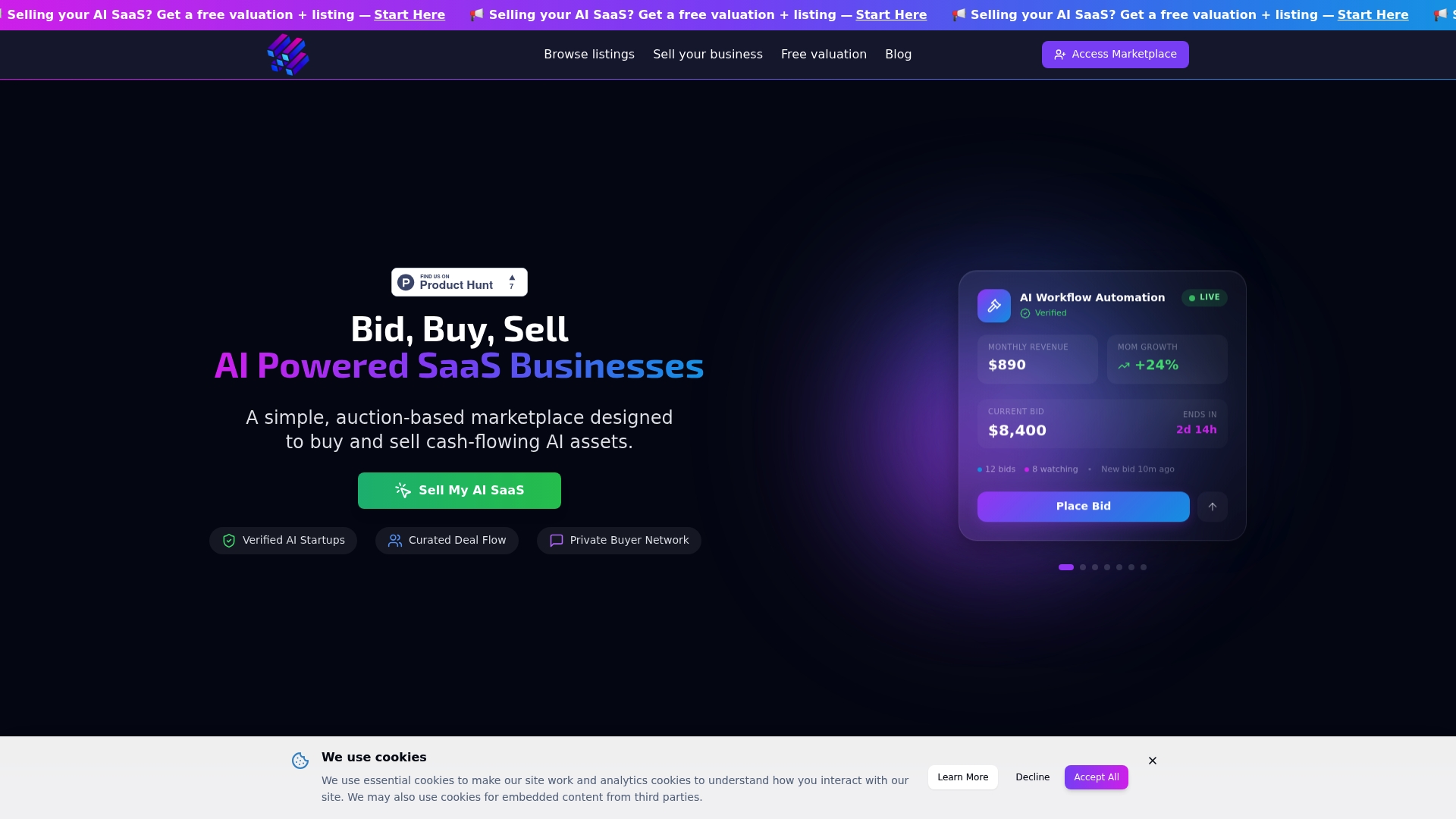
AIExchange.club is built specifically for this market. Every deal moves through a structured 6-stage pipeline (Kickoff, LOI, Due Diligence, APA, Escrow, Closing) with contracts signed in-platform and funds secured via Escrow.com. There are no listing fees, no subscriptions, and no broker markups. Just a flat 10% success fee when your deal closes, with a target close time under 14 days. If you are ready to find your next acquisition, take the buyer matching quiz to filter for deals that fit your thesis. If you are a founder with a revenue-generating AI tool, submit your business and let us find you a serious buyer.
Frequently asked questions
What is the average valuation multiple for AI SaaS at auction?
Valuation multiples typically range from 3x to 5x annual recurring revenue, with higher multiples going to businesses showing low churn and strong margins alongside clear AI defensibility.
How do I qualify my AI SaaS for an online auction?
Your product needs stable, verified revenue, transparent user metrics, and a scalable tech stack. Platforms look for product-led growth signals and clean financials as baseline qualifiers.
What are the biggest risks when buying at auction?
The most common risks are unverified revenue, hidden churn embedded in annual plan prepayments, and unclear IP ownership. Transparent product analytics and thorough due diligence are your best protection.
How quickly can an AI SaaS asset scale post-acquisition?
With focused execution on pricing, SEO, and AI upgrades, 2x to 4x MRR growth within one to two years is achievable based on real portfolio results.
Which sites or tools help buyers and sellers match efficiently?
Dedicated marketplaces like AIExchange and their built-in matching quizzes connect serious buyers with curated, vetted deals far faster than generic business-for-sale platforms.
Recommended
- Buy & Sell AI SaaS Businesses | AIExchange.club
- AI SaaS Acquisition Blog | AI Exchange Club
- Buy & Sell AI SaaS Businesses | AIExchange.club
- Buy & Sell AI SaaS Businesses | AIExchange.club
Article generated by BabyLoveGrowth
Ready to make a move?
Whether you're looking to acquire your next AI SaaS or list your business for the right buyer, AI Exchange Club connects vetted buyers and sellers with a flat 10% success fee.

Comments (0)
Be the first to share your thoughts.