
Most entrepreneurs assume that selling or buying an AI SaaS business is straightforward: find a willing party, agree on a price, and sign the paperwork. That assumption is expensive. The reality is that AI SaaS transactions are layered with technical due diligence, subscription revenue analysis, buyer qualification, and legal complexity that most founders and investors have never navigated before. Brokers are the professionals who turn that complexity into a smooth, value-maximizing process. Understanding exactly what they do and why it matters could be the difference between a deal that closes at peak value and one that falls apart at the finish line.
Table of Contents
- What is a broker in SaaS transactions?
- Key responsibilities and benefits brokers provide
- How brokers structure their involvement and fees
- Navigating the transaction: What to expect when working with a broker
- The real value of SaaS brokers: What most guides miss
- Turn your next SaaS move into a success with the right broker
- Frequently asked questions
Key Takeaways
| Point | Details |
|---|---|
| Brokers specialize in SaaS | SaaS brokers offer unique experience in software, recurring revenue, and tech deal-making. |
| Benefits outweigh the cost | The right broker can increase deal value and minimize risks for both buyers and sellers. |
| Transparent fee structures | Reputable brokers clearly explain their commission models and align incentives with your success. |
| Smooth, guided transactions | Working with a broker means more thorough due diligence, structured negotiations, and fewer surprises. |
| Choose experience and fit | Selecting a broker with proven SaaS deals and the right market connections is essential for a successful transaction. |
What is a broker in SaaS transactions?
A broker in the AI SaaS space is a specialized intermediary who connects qualified buyers and sellers of software businesses. But that definition barely scratches the surface. Unlike a traditional business broker who might sell a restaurant or a retail store, a SaaS broker brings a very specific skill set built around recurring revenue models, churn rates, net revenue retention, and technology stack evaluation.
Traditional brokers are trained to assess tangible assets: inventory, real estate, equipment. SaaS brokers, by contrast, spend most of their time analyzing intangible value drivers. They look at monthly recurring revenue (MRR), which is the predictable income a SaaS business generates each month from subscriptions. They evaluate customer acquisition cost (CAC) versus lifetime value (LTV). They assess technical debt, meaning the accumulated cost of shortcuts taken during software development, and how it might affect future scalability.
For AI SaaS businesses specifically, the complexity goes even deeper. Brokers need to understand how AI models are trained, whether proprietary datasets exist, and what happens to the product’s competitive edge if a key engineer leaves. These are not questions a generalist broker is equipped to answer.
Here are the core functions a SaaS broker performs:
- Buyer vetting: Confirming that prospective buyers have the financial resources and operational capability to close and run the business
- Business preparation: Helping sellers organize financials, documentation, and metrics into a compelling information memorandum
- Valuation: Applying SaaS-specific multiples and benchmarks to establish a defensible asking price
- Negotiation: Managing offer and counteroffer dynamics to protect the seller’s interests while keeping buyers engaged
- Paperwork and legal coordination: Overseeing letters of intent, asset purchase agreements, and transition documents
“A great SaaS broker doesn’t just find a buyer. They engineer the conditions under which the best possible buyer pays the best possible price under the best possible terms.” This is the standard that separates good brokers from exceptional ones.
If you want to understand how broker-led transactions play out in the AI space, the AI SaaS acquisition blog covers real deal structures and lessons from active marketplace participants.
Key responsibilities and benefits brokers provide
With an understanding of what brokers are, let’s explore the value they add through their core responsibilities. The list is longer than most sellers and buyers expect, and each item on it represents a potential deal-killer if mishandled.
1. Deal structuring and negotiation Brokers don’t just pass offers back and forth. They structure deals to account for earn-outs (where part of the purchase price is paid over time based on performance), asset versus stock sales, and transition service agreements. A poorly structured deal can expose a seller to liability or leave a buyer without adequate support post-close.
2. Due diligence coordination This is where most unassisted deals collapse. Due diligence in AI SaaS covers financials, customer contracts, technology audits, data privacy compliance, and intellectual property ownership. Brokers manage the flow of information, protect sensitive data through NDAs, and keep both parties on schedule.

3. Confidentiality management When a SaaS business goes to market without proper confidentiality controls, employees, customers, and competitors find out. That can trigger customer churn and employee departures before the deal even closes. Brokers implement staged disclosure processes that protect the business’s value throughout the sale.
4. Access to qualified buyer networks A seller going it alone is limited to whoever finds their listing organically. A broker brings a curated network of pre-qualified buyers who are actively looking, financially ready, and operationally capable. This dramatically shortens time to close and increases competitive tension around the deal.
5. Driving value through competitive bidding When multiple qualified buyers compete for the same asset, prices go up. Brokers know how to create and manage that competition ethically and effectively. This is one of the most direct ways a broker pays for their fee.
6. Legal and compliance oversight AI SaaS businesses often handle sensitive user data, operate under SaaS-specific terms of service, and may have compliance obligations under regulations like GDPR or CCPA. Brokers coordinate with legal counsel to ensure these issues are surfaced and resolved before they become deal-breakers.
| Broker responsibility | Benefit to seller | Benefit to buyer |
|---|---|---|
| Valuation | Maximizes asking price | Prevents overpaying |
| Due diligence management | Surfaces issues early | Reduces post-close surprises |
| Buyer network access | More qualified offers | Faster deal sourcing |
| Confidentiality controls | Protects business stability | Builds trust in process |
| Negotiation | Better terms and price | Structured, fair process |
| Legal coordination | Reduces liability exposure | Cleaner asset transfer |
Pro Tip: Ask any broker you’re considering to walk you through a recent deal they closed. The specifics of how they handled due diligence and negotiation will tell you far more than their pitch deck ever will.
Understanding broker fees and pricing upfront helps you evaluate whether the value a broker delivers justifies their cost before you sign any agreement.
How brokers structure their involvement and fees
Once you understand the impact of brokers, it’s essential to know how their compensation structures work and what to look out for. Fee models vary, and the wrong structure can misalign incentives in ways that hurt your deal.
Percentage of sale price (success fee) This is the most common model in SaaS brokerage. The broker earns a percentage of the final sale price, typically ranging from 8% to 15% for smaller deals and dropping to 3% to 6% for larger transactions above $1 million. Because the broker only gets paid when the deal closes, their incentives are directly aligned with maximizing the sale price and ensuring the transaction completes.
Fixed fee models Some brokers charge a flat fee for specific services, such as preparing an information memorandum or conducting a valuation. This can work well for sellers who want professional preparation without committing to a full brokerage relationship.
Retainer plus success fee A smaller number of brokers charge a monthly retainer to cover ongoing work, combined with a reduced success fee at closing. This model is more common for larger, more complex deals where the broker’s time investment is substantial and unpredictable.
| Fee model | Typical range | Best for | Risk |
|---|---|---|---|
| Success fee only | 8% to 15% | Deals under $500K | Broker may rush to close |
| Fixed fee | $2K to $10K | Preparation services | No closing incentive |
| Retainer plus success | $1K to $3K/month plus 3% to 5% | Complex deals over $1M | Higher upfront cost |
The most important thing to understand about broker fees is that they are not a cost. They are an investment. A broker who increases your sale price by 20% and charges a 10% success fee has still put more money in your pocket than going it alone. The math is straightforward, but many sellers fixate on the fee percentage rather than the net outcome.
Pro Tip: Always negotiate the definition of “sale price” in your broker agreement. Some brokers calculate their fee on the total deal value including earn-outs and non-compete payments. Others calculate it only on cash at close. The difference can be significant.
Transparency matters enormously here. Reviewing SaaS broker fee models before entering any agreement gives you a benchmark for what’s reasonable. If you’re ready to move forward, you can list your SaaS business or explore the private partners program for more tailored deal support.
Common pitfalls to avoid include brokers who ask for large upfront fees before delivering any results, those who guarantee a specific sale price before conducting proper analysis, and agreements with long exclusivity periods that lock you in without performance milestones.
Navigating the transaction: What to expect when working with a broker
Now that you’re clear on fee structures, let’s demystify what the transaction journey looks like with a broker by your side. Knowing the stages in advance helps you prepare, avoid delays, and manage your expectations realistically.
1. Initial engagement and business assessment The process starts with the broker reviewing your business metrics, financials, and growth trajectory. They’ll identify strengths to highlight and weaknesses to address before going to market. This stage typically takes one to three weeks.
2. Valuation and pricing strategy The broker applies SaaS-specific valuation methods, most commonly a multiple of annual recurring revenue (ARR) or seller’s discretionary earnings (SDE). For AI SaaS businesses, proprietary technology and data assets can significantly lift the multiple. Expect this stage to involve detailed back-and-forth as you align on a realistic asking price.
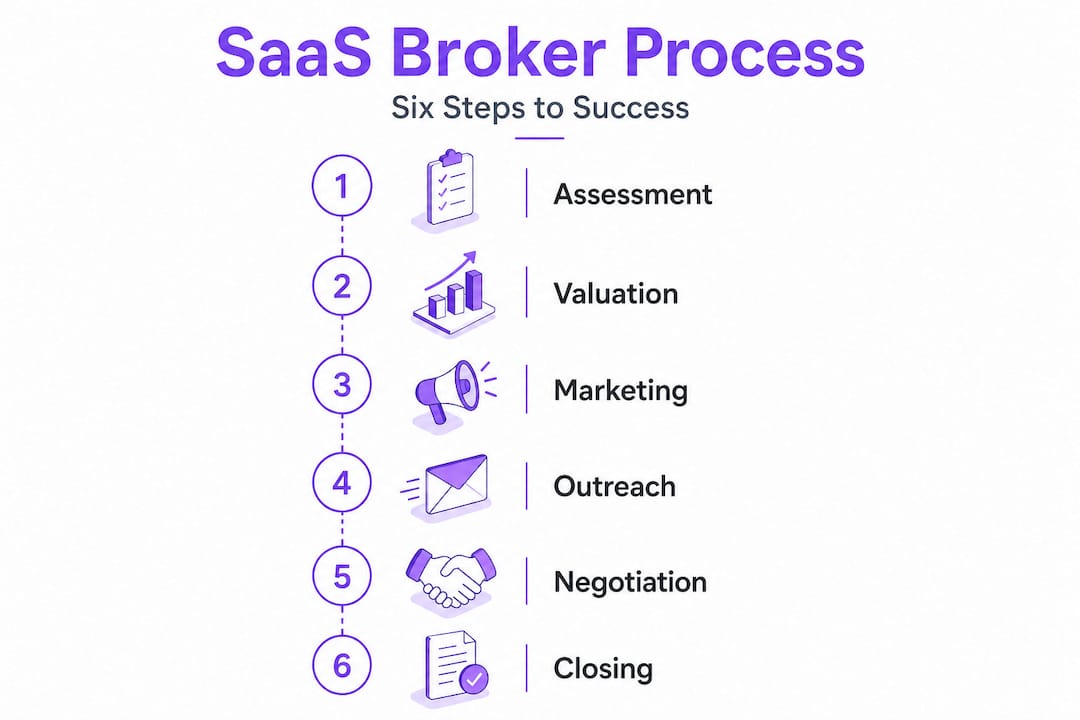
3. Preparation of marketing materials The broker creates a confidential information memorandum (CIM), a detailed document covering the business model, financials, technology, customer base, and growth opportunities. This is the document that serious buyers will use to make their initial assessment.
4. Buyer outreach and qualification The broker reaches out to their network, lists the business on relevant platforms, and screens inbound interest. Only buyers who sign an NDA and demonstrate financial qualification get access to the full CIM. This stage can last two to six weeks depending on market conditions.
5. Offer management and negotiation Qualified buyers submit letters of intent (LOIs). The broker manages multiple offers simultaneously, creating competitive tension and negotiating terms. This is where having an experienced broker pays off most visibly.
6. Due diligence and closing Once an LOI is accepted, the buyer conducts formal due diligence. The broker coordinates information requests, manages timelines, and problem-solves when issues arise. Closing involves finalizing legal documents, arranging escrow, and completing the business transfer.
Pro Tip: Don’t go dark during due diligence. Slow responses from sellers are one of the top reasons deals collapse at this stage. Your broker will guide you on what to share and when, but responsiveness is your job.
To find the right opportunity or match with sellers, you can find your ideal SaaS deal through a structured matching process that aligns your criteria with available assets.
The real value of SaaS brokers: What most guides miss
We’ve covered the practical aspects. Now let’s step back and consider the deeper value a great broker brings to the table, because most guides stop at the transactional and miss what actually makes the difference in high-stakes deals.
The best brokers are part strategist, part therapist, and part market analyst. Selling a business you’ve built is an emotionally charged experience. Founders often have unrealistic price expectations rooted in the years of effort they’ve invested rather than what the market will actually bear. A skilled broker navigates that emotional landscape carefully, helping founders separate their identity from the asset and make rational decisions under pressure.
We’ve seen deals in the AI SaaS space where a founder was ready to walk away from a legitimate offer because of a minor term disagreement during negotiation. The broker’s ability to reframe the conversation, focus on the total outcome, and de-escalate the tension saved the deal. That kind of counseling doesn’t show up in any fee schedule, but it’s often the most valuable thing a broker does.
Timing is another dimension that most guides ignore. The AI SaaS market moves in cycles, and the best brokers understand when to accelerate a sale and when to hold. Bringing a business to market during a surge in AI investor interest, for example, can lift valuations significantly compared to listing during a quiet period. Brokers who track deal success stories and market trends actively use that intelligence to time their clients’ listings for maximum impact.
Finally, the best brokers are exceptional at identifying fit beyond the financials. The “right” buyer isn’t always the highest bidder. It’s the buyer who has the operational capability to grow the business, the technical background to maintain the AI stack, and the strategic vision that aligns with what the seller has built. A broker who prioritizes fit over speed creates better outcomes for both parties and reduces the risk of post-close disputes.
Turn your next SaaS move into a success with the right broker
Having gained deeper insight into what brokers do and why they matter, here’s how to take the next confident step in the AI SaaS marketplace.
Whether you’re selling a cash-flowing AI SaaS business or looking to acquire one, working with a broker who specializes in this space is one of the highest-leverage decisions you can make. Brokers reduce risk, increase deal value, and compress timelines in ways that consistently outperform solo transactions.
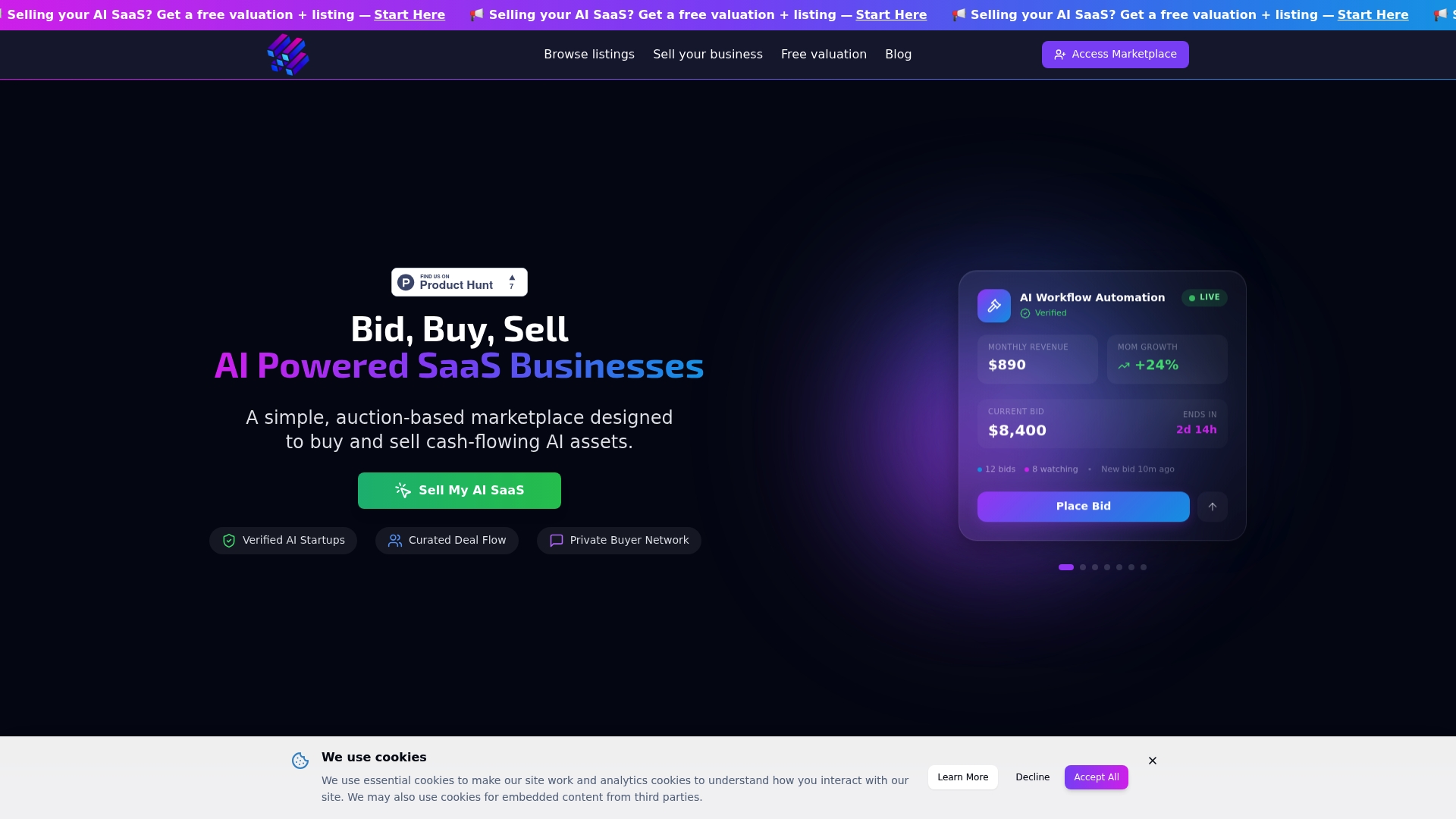
At AIExchange.club, the AI SaaS market is built around exactly this kind of specialist broker support. You can list your AI SaaS business with free listing and a success-based fee, or get matched to buyers through a structured process that connects you with verified, qualified acquirers. The platform combines live broker facilitation, standardized legal templates, and secure escrow through Escrow.com to make every transaction as smooth and safe as possible.
Frequently asked questions
Are SaaS brokers worth the fee they charge?
For most deals, brokers increase the final transaction price and reduce risk enough that sellers net more money even after paying the broker’s fee. The value is clearest in competitive, multi-offer situations.
How can I verify if a SaaS broker is reputable?
Look for transparent fee structures, a documented history of closed SaaS deals, and verifiable client references. Insist on a written agreement with clearly defined deliverables and timelines before committing.
What are red flags when choosing a SaaS broker?
Avoid brokers who guarantee a specific sale price before conducting proper analysis, demand large upfront fees, or are vague about their buyer network and process. Long exclusivity periods without performance milestones are also a warning sign.
Can I use a non-specialized business broker for SaaS deals?
You can, but SaaS-specialist brokers bring critical expertise in recurring revenue valuation, technical due diligence, and subscription metrics that generalist brokers typically lack. For AI SaaS specifically, that specialization is even more important.
How are broker fees typically structured in SaaS deals?
Most SaaS brokers charge a percentage of the final sale price, ranging from 8% to 15% for smaller deals, and only collect their fee when the deal successfully closes.
Recommended
- Buy & Sell AI SaaS Businesses | AIExchange.club
- AI SaaS Acquisition Blog | AI Exchange Club
- Buy & Sell AI SaaS Businesses | AIExchange.club
- Buy & Sell AI SaaS Businesses | AIExchange.club
Ready to make a move?
Whether you're looking to acquire your next AI SaaS or list your business for the right buyer, AI Exchange Club connects vetted buyers and sellers with a flat 10% success fee.

Comments (0)
Be the first to share your thoughts.