
Buying a cash-flowing AI SaaS business sounds straightforward until you realize how many buyers lose money by choosing the wrong marketplace, skipping verification steps, or misreading revenue figures. Primary auction-based marketplaces for buying AI SaaS businesses include Acquire.com, Flippa, Empire Flippers, MicroAcquire, and UnicornMarket, each with different fee structures, vetting standards, and deal sizes. This guide walks you through every stage of the acquisition process, from picking the right platform to signing off on escrow, so you can move fast and buy smart.
Table of Contents
- Understand the AI marketplace landscape
- Define your acquisition criteria
- Step-by-step: How to buy on an AI SaaS marketplace
- Common mistakes and how to avoid them
- What most buyers get wrong about AI SaaS marketplaces
- Find your next AI SaaS business with AIExchange.club
- Frequently asked questions
Key Takeaways
| Point | Details |
|---|---|
| Know your marketplaces | Different AI SaaS marketplaces have unique fee models, vetting standards, and deal sizes. |
| Define your criteria first | Setting clear goals for cash flow, size, and risk ensures smarter deal sourcing. |
| Follow a proven process | Screen, verify, negotiate, and close your deal for the best outcome and minimal risk. |
| Avoid common pitfalls | Skipping due diligence or misunderstanding fees can reduce your ROI and increase risk. |
| Smart buyers look deeper | Great deals and lower risk are found by combining personal diligence with platform research. |
Understand the AI marketplace landscape
Before you place a single bid or send a single inquiry, you need a clear picture of where legitimate AI SaaS deals actually live. Not all platforms are created equal. Some specialize in micro-SaaS deals under $50K, while others focus exclusively on high-revenue businesses with verified financials. Understanding these differences upfront saves you weeks of wasted effort.

The primary auction-based marketplaces for AI SaaS include Acquire.com, Flippa, Empire Flippers, MicroAcquire, and UnicornMarket. Each platform targets a different buyer profile and deal size, so matching yourself to the right one from the start is critical.
Here is a quick comparison of the major platforms:
| Platform | Buyer fee | Deal range | Vetting level |
|---|---|---|---|
| Acquire.com | Free | $10K to $5M+ | High (verified MRR) |
| Empire Flippers | Free | $50K to $5M+ | Very high (full audit) |
| Flippa | 5 to 15% success fee | $1K to $5M+ | Medium (self-reported) |
| MicroAcquire | Free | $1K to $500K | Medium (buyer verifies) |
| UnicornMarket | 5% success fee | $1K to $50K MRR | Medium |
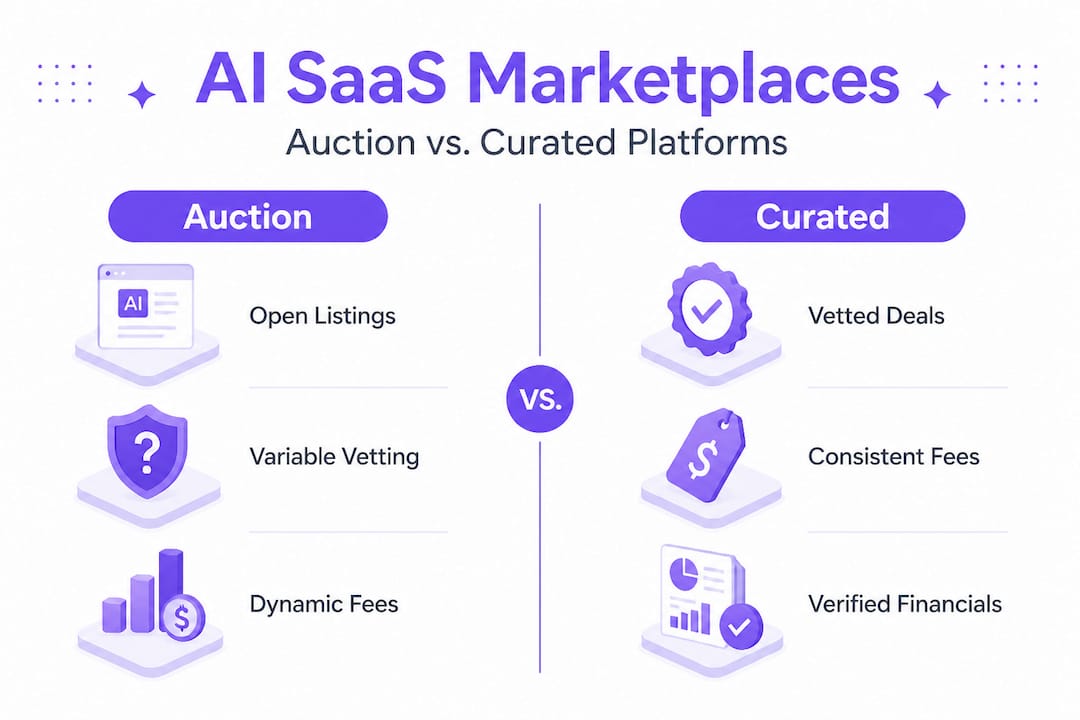
You can also explore trusted AI SaaS marketplaces that specialize specifically in AI-driven products, which narrows the deal flow to businesses with genuine AI components rather than generic SaaS tools.
Here is what each vetting level actually means in practice:
- High vetting: The platform independently verifies MRR, churn rate, and customer counts before listing. Sellers must connect their Stripe or payment processor.
- Medium vetting: Sellers self-report financials, and buyers are expected to verify during due diligence. The platform may spot-check but does not guarantee accuracy.
- Low vetting: Listings go live with minimal review. Buyer beware applies in full force here.
The fee model also matters more than most buyers realize. A platform that charges buyers nothing may still cost you indirectly through inflated asking prices or limited negotiation room. Auction-based platforms often create competitive bidding environments that drive prices up quickly, so knowing your ceiling before you enter a bidding process is essential.
Pro Tip: Always check whether a marketplace charges a buyer success fee, a seller success fee, or both. On some platforms, the seller’s fee is baked into the asking price, which means you are effectively paying it anyway.
Define your acquisition criteria
With a clear view of the marketplace options, your next step is defining exactly what you want from your AI SaaS purchase. Many buyers skip this step and end up chasing deals that look exciting but do not fit their skills, budget, or growth goals. That is a fast path to overpaying or buying a business you cannot operate.
Start with your budget. Marketplaces like Empire Flippers and Acquire.com focus on SaaS deals from $10K to $5M+, while MicroAcquire and UnicornMarket support smaller and micro-SaaS deals starting at $1K. Knowing which tier you are shopping in tells you exactly where to focus your search.
Your acquisition criteria should cover these key dimensions:
- Budget range: What is your maximum purchase price, and how much cash do you have available for post-acquisition growth?
- Monthly recurring revenue (MRR): What minimum MRR do you need the business to generate to justify the purchase price and your time?
- Churn rate: A business with 3% monthly churn loses roughly a third of its revenue every year. Set a maximum acceptable churn threshold before you start browsing.
- Technical complexity: Can you maintain the product yourself, or will you need to hire engineers? Factor that cost into your ROI calculation.
- Revenue multiple: Most AI SaaS businesses sell for 3x to 5x annual profit. Knowing your target multiple helps you spot overpriced listings immediately.
- Growth stage: Are you looking for a stable cash cow or a high-growth business that needs active management?
Matching your criteria to the right marketplace is equally important. If you want a fully vetted deal with verified financials and a clean handover process, Empire Flippers or Acquire.com are your best starting points. If you are comfortable doing more verification yourself in exchange for lower prices and more deal flow, MicroAcquire or Flippa may work better.
Check the marketplace fees and price ranges for each platform before you commit to one, because the true cost of acquisition includes more than just the asking price. You should also consider using a buyer matching quiz to identify which platform and deal type aligns with your specific goals. These tools take your budget, skills, and risk tolerance into account and point you toward the most relevant listings.
Step-by-step: How to buy on an AI SaaS marketplace
You know your buying criteria and which platforms match. Now let’s walk step-by-step through the actual buying process. The good news is that buyer processes are similar across leading AI SaaS marketplaces, typically involving deal selection, due diligence, negotiation, and escrow. Here is how each stage works in practice.
-
Register and verify your buyer profile. Most platforms require identity verification and proof of funds before you can access detailed financials. This protects sellers from tire-kickers and speeds up the process for serious buyers.
-
Use filters to find relevant deals. Filter by revenue range, business model (subscription vs. usage-based), industry vertical, and asking price. Save your search criteria so you get notified when new listings match your profile.
-
Request a listing information memorandum (IM). This is the detailed document that covers revenue history, customer breakdown, tech stack, and growth opportunities. Signing an NDA is usually required first. Review the NDA and confidentiality steps on your chosen platform before you proceed.
-
Conduct structured due diligence. This is where most buyers either win or lose the deal. Here is what to verify:
| Due diligence area | What to check | Red flags |
|---|---|---|
| Revenue | Stripe/payment processor access | Inconsistent MRR, manual invoices |
| Churn | Monthly cohort data | Churn above 5% monthly |
| Traffic | Google Analytics or equivalent | Sudden traffic spikes before listing |
| Contracts | Customer agreements, SLAs | Month-to-month only, no lock-in |
| Tech stack | Code quality, hosting costs | Undocumented code, high server costs |
| Legal | IP ownership, trademarks | Shared IP, unresolved disputes |
-
Negotiate the deal structure. Price is only one variable. You can negotiate on earnouts (where part of the payment depends on future performance), transition support periods, and asset transfer timelines. Read more about purchasing an AI SaaS business to understand how deal structures typically work.
-
Move to escrow and close. Once both parties agree on terms, funds go into escrow. The seller transfers all assets, including code, domains, customer data, and documentation. You verify everything is in order, then release payment. Never transfer funds outside of an escrow arrangement.
Pro Tip: Always request a 30-day transition support period from the seller as part of your deal terms. This gives you time to get up to speed on the product, meet key customers, and catch any undisclosed issues before the seller is fully off the hook.
Common mistakes and how to avoid them
Even seasoned buyers make missteps. Let’s look at frequent pitfalls and how you can sidestep them.
Vetting and fee models differ greatly between platforms, which directly impacts buyer risk. A deal that looks clean on a low-vetting platform may have serious hidden problems that a more rigorous platform would have caught before listing.
Here are the most common mistakes buyers make:
- Trusting self-reported MRR without verification. Sellers can inflate MRR by counting one-time payments as recurring revenue. Always connect to their payment processor directly and pull the raw data yourself.
- Ignoring churn in favor of top-line revenue. A business with $30K MRR and 8% monthly churn is shrinking, not growing. Calculate net revenue retention before you make any offer.
- Misunderstanding the fee structure. Some platforms charge a buyer success fee that is not obvious at first glance. Others charge listing fees, due diligence fees, or escrow fees on top of the purchase price.
- Skipping the tech audit. AI SaaS businesses often rely on third-party APIs, like OpenAI or Anthropic. If the business has no fallback and the API pricing changes, your margins can collapse overnight. Always audit the tech dependencies.
- Not having a clear handover plan. Who is transferring the domain? Who handles the customer data migration? A vague handover process leads to downtime, customer complaints, and lost revenue.
“The biggest risk in buying an AI SaaS business is not the price you pay. It is the information you did not ask for.”
Review understanding NDAs and buyer protections before you sign anything. A solid NDA protects you during due diligence and gives you legal recourse if the seller misrepresents the business.
What most buyers get wrong about AI SaaS marketplaces
Here is a perspective you rarely hear from platform insiders or serial buyers: the marketplace brand does not protect you. Buyers assume that because a deal appears on a well-known platform, it has been thoroughly vetted. That is often not true.
Even on high-vetting platforms, the due diligence process is designed to verify what the seller discloses, not to uncover what they choose to hide. A seller who deliberately omits a major customer cancellation or a pending legal dispute can pass platform verification and still hand you a broken business. Your personal diligence is the only real protection you have.
There is also a widespread belief that bigger platforms always mean better deals. In practice, the most competitive deals on large platforms are often bid up to prices that leave little room for error. Some of the best acquisitions happen on newer or more specialized platforms where deal flow is smaller but buyer competition is lower. AI SaaS acquisition insights from niche platforms often reveal opportunities that never make it to the big marketplaces.
The third misconception is that the listed price is your total cost. It is not. Beyond the purchase price, you need to budget for escrow fees, legal review, post-acquisition development, potential API cost increases, and the time you will spend on the transition. A $100K deal can easily cost $115K to $125K all in once you account for these factors. Buyers who ignore this end up cash-strapped in the first 90 days, which is exactly when you need capital to stabilize and grow the business.
The smartest buyers we have seen treat the marketplace as a sourcing tool, not a safety net. They use platform vetting as a first filter, then apply their own rigorous diligence process regardless of the platform’s reputation. That mindset shift alone separates buyers who build strong portfolios from those who end up with expensive lessons.
Find your next AI SaaS business with AIExchange.club
If you are ready to act on what you have learned, AIExchange.club is built specifically for buyers like you.
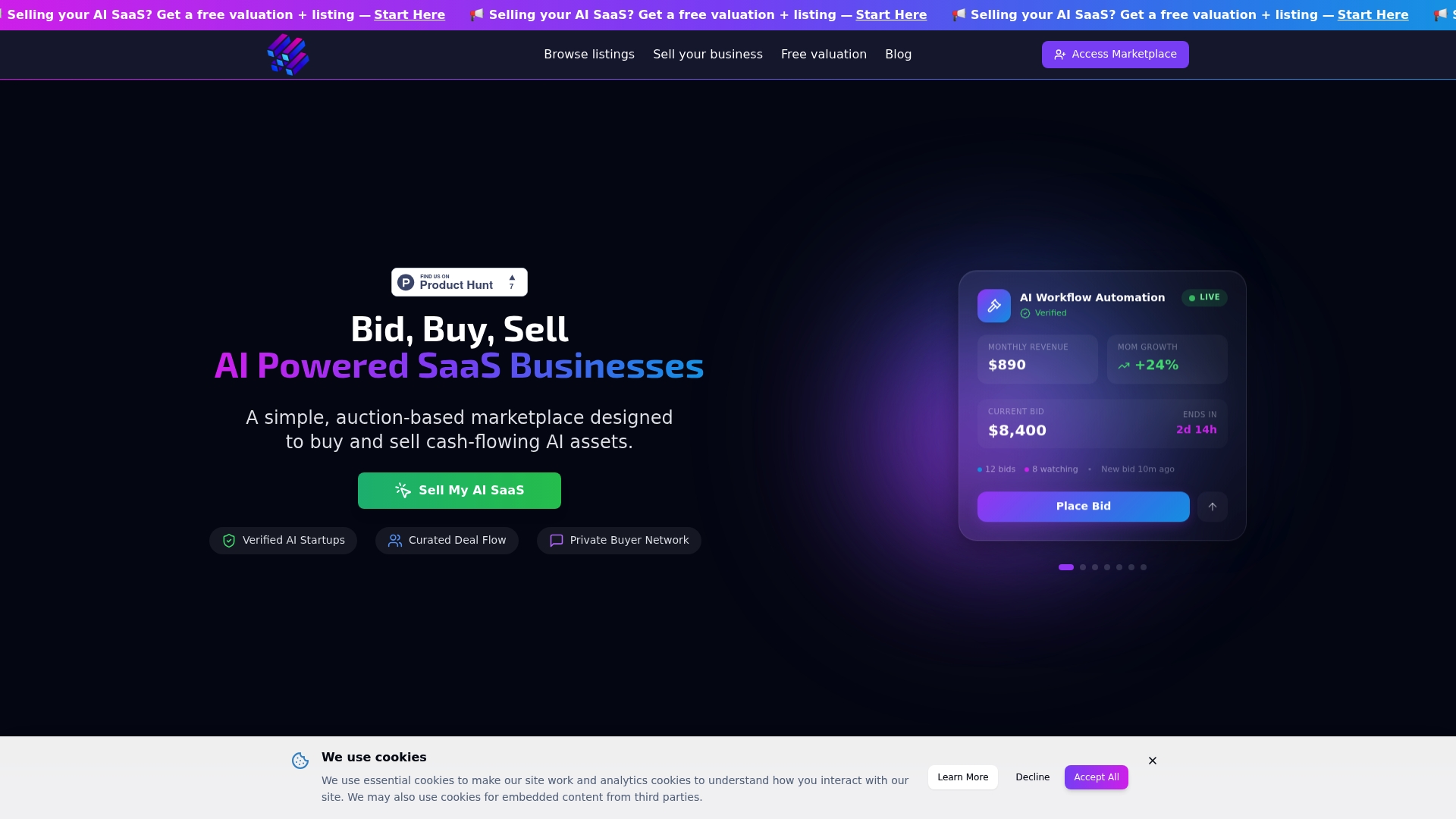
AIExchange.club is a specialized marketplace for cash-flowing AI SaaS businesses, with features designed to make the acquisition process faster and safer. You can use the buyer matching tool to identify which deals fit your budget, skills, and revenue targets in minutes. The platform offers full fee transparency, so you can review the up-to-date fee schedule before you commit to anything. Secure escrow payments via Escrow.com protect every transaction, and dedicated brokers are available to facilitate live deal negotiations. Ready to start sourcing? Explore current listings and find your next AI SaaS acquisition today.
Frequently asked questions
Which AI SaaS marketplaces have the lowest buyer fees?
Acquire.com and MicroAcquire are free for buyers, while Flippa charges a 5 to 15% success fee and UnicornMarket charges a 5% fee on completed deals.
Can I negotiate the price of an AI SaaS business on auction marketplaces?
Yes, most AI SaaS marketplaces allow direct negotiation and counteroffers, and deal terms like earnouts and transition support are often negotiable even after an initial bid.
How do I know if a SaaS listing is legitimate and profitable?
Choose platforms that vet listings and verify financials before publishing, and always request direct access to payment processor data and analytics during due diligence.
What payment methods are used to buy AI SaaS businesses?
Most platforms use escrow services for secure payments, holding funds until all assets are transferred and verified by the buyer before releasing payment to the seller.
Recommended
- AI SaaS Acquisition Blog | AI Exchange Club
- Buy & Sell AI SaaS Businesses | AIExchange.club
- Buy & Sell AI SaaS Businesses | AIExchange.club
- Buy & Sell AI SaaS Businesses | AIExchange.club
Ready to make a move?
Whether you're looking to acquire your next AI SaaS or list your business for the right buyer, AI Exchange Club connects vetted buyers and sellers with a flat 10% success fee.

Comments (0)
Be the first to share your thoughts.