
A standardized M&A contract is a fixed template for the recurring parts of a deal: the structure, price mechanics, representations, indemnity limits and closing steps. Only the business-specific facts change. For small AI SaaS deals this is the practical way to close, because the legal cost of a fully custom agreement can exceed what the deal is worth. At AI Exchange Club, which is a marketplace for AI SaaS businesses, every deal closes through escrow with standardized contracts, listings are free, and the fee is a flat 10% with no monthly fees.

This guide explains what standardization covers, what still gets negotiated, and how to read a template as a buyer or seller of an AI SaaS product.
TL;DR
- Standardization covers boilerplate and the clause architecture. Price, disclosures and a few risk limits are still set per deal.
- Large-deal agreements are heavily customized. A small AI SaaS sale needs a much shorter agreement, so a template fits it well.
- Most micro-SaaS deals are asset purchases, so the template should name the code, domains, accounts, customer data and IP being transferred.
- AI products need extra terms: model and API dependencies, open-source and third-party code, training data and privacy.
- On our marketplace, listing is free, the success fee is a flat 10% with no monthly fees, and deals close through Escrow.com on standardized contracts.
What “standardized” actually means in M&A
No major M&A agreement is fully standard. Academic researchers describe these contracts as “mass customized”: produced at scale from familiar modules, then tailored to each deal (Jennejohn, The Architecture of Contract Innovation). Boilerplate, in the NYU definition, means standardized terms meant to keep a consistent meaning across transactions. Its appeal is legal certainty and drafting efficiency (Anderson and Manns, Boiling Down Boilerplate).
The same paper warns about the weak point. When lawyers edit a template heavily, each addition and deletion can change what the original language meant, and the “standard” text stops being standard.
The scale of that drift is measurable. A Georgetown Law Review study of about 12,000 merger agreements from 1994 to 2014 found the median length grew from roughly 21,000 words to roughly 39,000. It also found a median edit of 21,866 words between the precedent a lawyer started from and the final draft, which is more than half the text. Even deals from the same law firm varied widely (The Inefficient Evolution of Merger Agreements). A separate Harvard and Wharton study of 564 large all-cash deals found average contract length grew 163%, from about 35 pages to about 88 pages, over the same period (same source).
The lesson for a founder is simple. Those numbers describe deals worth hundreds of millions of dollars. For a $30,000 or $300,000 AI tool, you do not want an 88-page agreement. You want a short, consistent template that both sides can read in one sitting.
Why small deals suit templates
The American Bar Association’s Model Stock Acquisition Agreement says in its preliminary note that it is a resource for a buyer’s first draft. Its provisions generally favor the buyer, are not typical of fully negotiated final language, and are normally tailored to the size and nature of the business (ABA Model Stock Acquisition Agreement, Preliminary Note). Practitioners also note that for relatively small transactions the agreement will likely be shorter and far less comprehensive than that model (Velocity Law).
That is the case for standardizing a micro-SaaS sale:
- Fewer moving parts. One product, a small team or one founder, a handful of vendors and customers.
- Predictable risks. Code ownership, revenue accuracy, customer contracts and platform dependencies show up in nearly every deal.
- Speed. A template removes weeks of drafting back and forth, which matters when a buyer is deciding between several listings.
- Fairness you can see. When both parties sign the same form that others sign, neither side has to wonder whether the other slipped in an unusual term.
The cost of a template is the risk that it does not fit your product. That is why the useful question is not “is it standard?” but “which parts are fixed, and which blanks do we fill in?”
The document stack in a deal
A U.S. private deal moves through a recognizable sequence. The Association of Corporate Counsel’s guide lists it: a short teaser with no confidential information, then a nondisclosure agreement, then a detailed confidential information memorandum, management presentations, due diligence, a letter of intent that settles the fundamental terms and builds momentum, and finally the definitive purchase agreement plus employment and noncompete agreements (ACC, M&A Nuts and Bolts).
| Document | What it does | Binding? |
|---|---|---|
| NDA | Protects financials, code and customer data shared during diligence | Yes |
| Letter of intent (LOI) | Sets price, structure, timeline and exclusivity | Mostly no, except confidentiality and exclusivity |
| Definitive agreement (APA or stock purchase) | Price mechanics, representations, covenants, closing conditions, indemnity | Yes |
| Disclosure schedules | List exceptions to the seller’s representations | Part of the agreement |
| Escrow and ancillary documents | Hold funds, assign IP, transfer accounts | Yes |
The LOI deserves a closer look. It is generally non-binding except for confidentiality and similar matters, and private-deal LOIs often include a no-shop exclusivity covenant commonly lasting 30 to 60 days (Baker McKenzie, U.S. preliminary documents). A U.S. practitioner view is that a well-made LOI separates agreed points from real issues and tends to lower overall transaction costs (Kurtin Law). For a seller, that means exclusivity is the one LOI term worth reading twice: you are taking your listing off the market for that period.
The clauses that carry the risk

A typical private acquisition agreement has operative terms (structure, price, escrow mechanics), seller representations and warranties qualified by disclosure schedules, covenants, and indemnification with caps, baskets, survival periods and escrow security (Griffin, Business Acquisition Agreements). This is where standard forms do most of their work, because these are the clauses that allocate risk between you and the other side.
The same chapter reports typical lower-middle-market ranges. They are useful as a reference point, not as a promise of what any template contains:
| Term | Typical range |
|---|---|
| Cap on general representations | 10% to 15% of price |
| Cap on fundamental representations | 100% of price |
| Basket (deductible threshold) | 0.5% to 1% of price |
| Survival of general representations | 12 to 24 months, 18 most common |
| Escrow holdback | 5% to 15%, usually 10%, for 12 to 24 months |
Here is what those terms mean in plain language:
- Representations and warranties are the seller’s statements of fact: the revenue figures are accurate, the seller owns the code, there are no undisclosed claims.
- Disclosure schedules are the list of exceptions. A seller who discloses a problem there is generally protected against a claim for that problem.
- A cap limits how much the seller can owe after closing. A basket is the amount of losses that must accumulate before claims start.
- Fundamental representations (usually ownership, authority and tax) get higher caps and longer survival, because they go to the heart of what the buyer paid for.
- Survival is how long after closing a buyer can bring a claim.
We cover these statements in more depth in our guide to representations and warranties in an AI SaaS sale.
Asset purchase or stock purchase
The structure decides what the template has to say. In a SaaS asset purchase, the buyer acquires specific assets such as code, IP, customer contracts, data and domains, and the seller’s entity keeps liabilities the buyer does not assume. Buyers generally prefer this for scope control, limited legacy exposure and a tax basis step-up. In a stock purchase the buyer acquires the company itself and inherits its assets and liabilities, which sellers often prefer for tax reasons (Revision Legal).

Asset deals often need third-party consents to assign contracts, while stock deals need consents only where a contract has a change-of-control clause (Linden Law Partners). Mergers, the third route, transfer obligations by statute and mostly appear in venture-backed company sales rather than small product sales.
For an indie AI product that lives in one repository with a Stripe account and a domain, the asset purchase is the natural fit. Our seller’s guide to the asset purchase agreement walks through the schedule of assets in detail.
Where a standard form needs AI-specific terms
A generic business template misses the things that make a software product valuable or risky. Practical Law’s guide to software-centered M&A lists the software-specific representations buyers typically ask for: disclosure of software products, open-source use, modification and transfer, source code protection and escrow, conformance to specifications, freedom from viruses and malicious code, IT performance and security, and privacy and data security compliance. It also says buyer’s counsel must confirm the seller has clear title to the proprietary software, or exclusive control through license, and the power to convey it (Practical Law, Negotiating Software-centered M&A Transactions).
For an AI SaaS product, translate that into a short list of blanks the template should have you fill in:
- Code ownership. Who wrote it, under what agreements, and was any of it generated or contributed by contractors?
- Open-source and third-party code. Which licenses apply, and do any restrict commercial transfer? See what buyers check in code license compliance for AI SaaS.
- Model and API dependencies. Which providers does the product call, under which account, and can that account transfer?
- Customer data and privacy. What data is stored, where did it come from, and what do the privacy policy and terms of service allow?
- Prompts, fine-tunes and datasets. Are they part of the assets being transferred, and does the seller have the right to transfer them?
- Transition support. How long will the seller help with handover, and what does it cover?
Buyers verify most of these in diligence before signing. Our AI SaaS due diligence guide and technical due diligence guide show what to check, and the due diligence checklist covers the wider business.
What does not need to be in your contract
Much of what dominates large-deal agreements does not apply to a micro-SaaS sale. The federal Hart-Scott-Rodino premerger filing, for example, applies above a size-of-transaction threshold, listed at $133.9 million effective February 17, 2026 (Mandelbaum Barrett). A deal under $100,000 sits far below it. Treat that as a reason a short form is realistic, not as legal advice on your specific deal. Industry-regulated products, such as those handling health or financial data, can raise separate questions that belong in the disclosure schedules.
How the six stages use standardized contracts on our marketplace
Our marketplace is built for AI SaaS businesses, and each deal runs through the same six stages: Kickoff Call, LOI, Due Diligence, APA or ATA, Escrow and Closing. Legal documents are generated and signed in-platform through DocuSeal, and funds are held by Escrow.com. Our target close time is under 14 days.
Here is how that maps to the document stack above:
- Kickoff Call. Buyer and seller confirm the basics of the deal before paperwork starts.
- LOI. The agreed price and structure go into a standard letter rather than a custom draft.
- Due Diligence. The buyer verifies what the seller has stated. Our platform includes revenue and code quality verification, and listings are protected by NDA.
- APA or ATA. The standardized purchase agreement is generated and signed in-platform, so both sides work from the same form.
- Escrow. Funds sit with Escrow.com, not with either party.
- Closing. Assets transfer and the funds are released. Our closing checklist for SaaS deals lists what to have ready.
The point of building the process around one set of contracts is consistency. You know the shape of the agreement before you list or bid, so negotiation focuses on the price and the specifics of your product instead of on the form.
Our view on standard contracts
The research above shows a real tension: custom drafting drifts, grows longer and costs more, while a form that never adapts misses the risks of the product it covers. For small AI SaaS deals we land firmly on the side of standardization, with the product-specific facts filled in on the schedules.
The reason is practical. A solo founder selling an AI wrapper and an indie buyer acquiring their first tool should not need a six-figure legal budget to trade a business. When contracts are standardized and funds sit in escrow, both sides can judge the deal on the numbers: revenue, code quality, churn and the price.
That is why every deal on AIExchange.club closes through escrow with standardized contracts, why listing is free, and why our fee is a flat 10% with no monthly fees, paid only when a deal closes.
Phillip
Sell or buy an AI SaaS business on standardized terms
If you are selling, listing on AIExchange.club is free. We charge a flat 10% success fee only when a deal closes, with no monthly fees, and our free valuation quiz can give you a data-backed number before you list. If you are buying, our Marketplace Membership is $49 per month or $399 per year for full marketplace access, and you can also join the private buyer network for targeted deal matching.
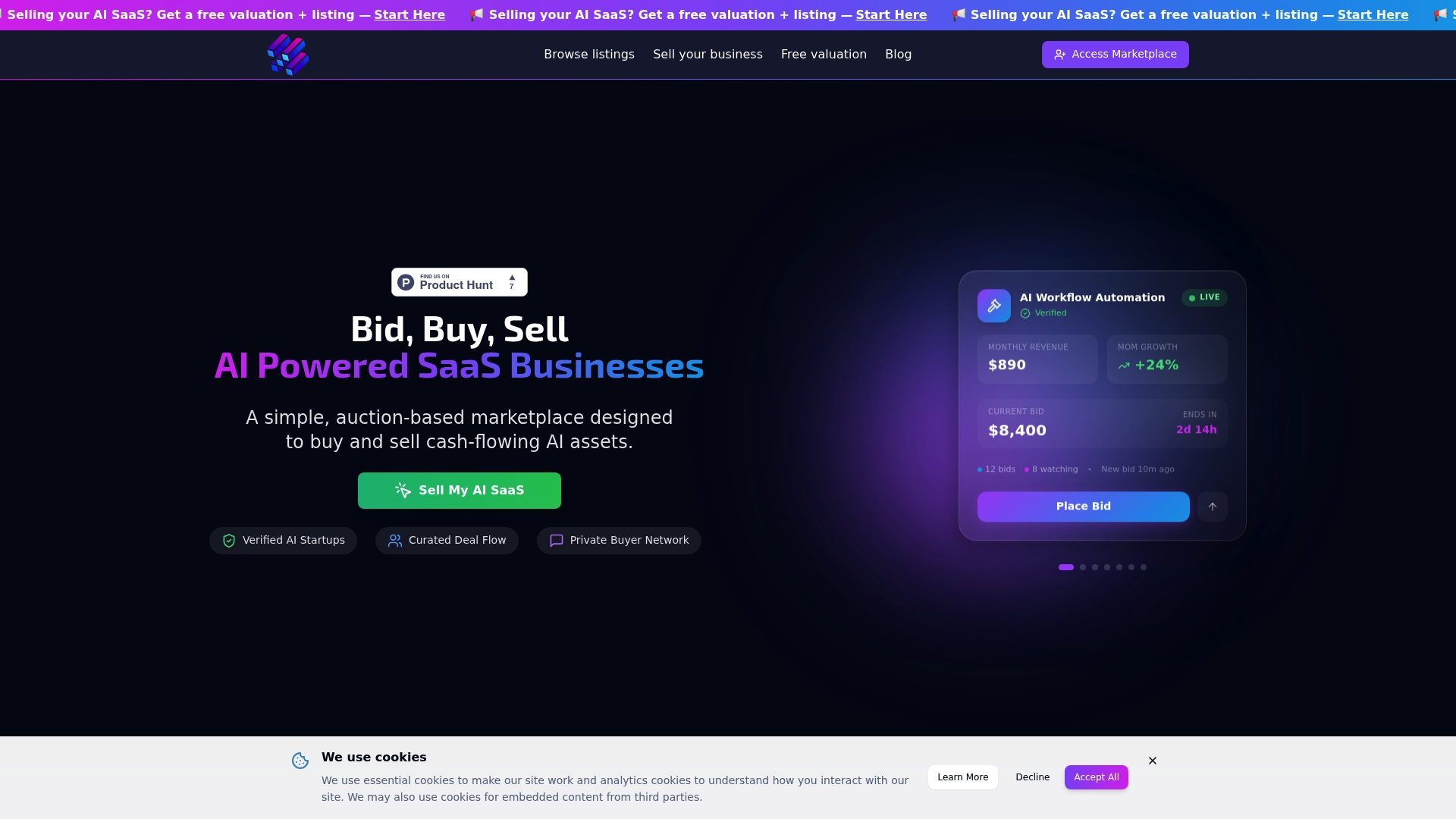
Start with the AI SaaS valuation quiz, then list your AI SaaS business when you are ready. Pricing details are on our pricing page.
FAQ
What does it mean when a contract is standardized?
It means the recurring terms, such as definitions, representation structure, indemnity mechanics and closing steps, come from a fixed form instead of being drafted fresh each time. The deal-specific facts, like price, assets and disclosures, are filled in. Academic work describes real M&A agreements as a mix of standard and customized parts.
Can I change a standardized agreement?
Yes, within the blanks and schedules. Price, the asset list, disclosures and transition terms are meant to be set per deal. Heavy edits to the core language can change its meaning, which the NYU boilerplate research warns about, so keep edits focused on facts specific to your product.
What are the main documents in an AI SaaS acquisition?
An NDA, a letter of intent, the definitive agreement (usually an asset purchase agreement for small AI products), disclosure schedules, and escrow and transfer documents. On our marketplace, those run through a six-stage pipeline with in-platform signing and Escrow.com.
Are the terms in a template the same as market terms?
Not automatically. Published ranges, such as a 10% to 15% cap for general representations and a typical 10% escrow holdback, describe lower-middle-market practice. Read the specific cap, basket, survival period and escrow terms in your agreement and compare them with your deal size.
Does a small AI SaaS deal need an HSR filing?
Almost never. The federal threshold is listed at $133.9 million for 2026, far above micro-SaaS prices. State notice rules and industry-specific rules can still apply in some situations, so list any regulated data in your disclosure schedules.
Sources
- Jennejohn, The Architecture of Contract Innovation
- Anderson and Manns, Boiling Down Boilerplate in M&A Agreements
- The Inefficient Evolution of Merger Agreements
- ABA Model Stock Acquisition Agreement, Preliminary Note
- Velocity Law, Traps for the Unwary
- ACC, M&A Nuts and Bolts
- Baker McKenzie, U.S. preliminary documents
- Kurtin Law, LOIs, MOUs and Term Sheets
- Griffin, Business Acquisition Agreements
- Revision Legal, SaaS Acquisition Lawyer
- Linden Law Partners, Asset vs. Stock Purchase vs. Merger
- Practical Law, Negotiating Software-centered M&A Transactions
- Mandelbaum Barrett, M&A Strategy in 2026
Recommended
AI SaaS businesses for sale right now

AI Business Broker | Helping AI SaaS founders secure confidential exits | 2.16M in AUM
Comments (0)
Be the first to share your thoughts.


