
A SaaS auction marketplace is a site where a founder lists a software business, buyers bid against each other for it in a live auction (or make a direct offer), and the deal closes through escrow instead of a handshake. AIExchange.club is that marketplace for AI SaaS businesses: listing is free, the fee is a flat 10% success fee with no monthly fees, and every deal closes through escrow with standardized contracts.

If you are selling a ChatGPT wrapper, an AI agent or a vibe-coded side project that earns revenue, or buying one, this guide covers the mechanics: what an auction is, how a deal moves from listing to closing, what to verify, and what it costs.
TL;DR
- An AI SaaS auction marketplace lets buyers compete in a live auction or submit offers on revenue-generating AI software, without a broker or a six-figure minimum.
- On AIExchange.club, listings are free. The fee is a flat 10% success fee, paid only when a deal closes, with no monthly fees.
- Every deal runs through a 6-stage pipeline (Kickoff, LOI, Due Diligence, APA, Escrow, Closing) with standardized contracts and funds held by Escrow.com. The target close time is under 14 days.
- Buyers should verify revenue, AI model dependency and inference cost per customer before bidding. Sellers should prepare clean numbers before listing.
What a SaaS auction marketplace is (and is not)
The phrase confuses two different things. A cloud app store, where companies buy subscriptions to software, is also called a SaaS marketplace. That is not what this page is about.
A SaaS auction marketplace sells the whole business: the code, the domain, the customer list, the brand and the integrations. The buyer is acquiring an asset, not a subscription. For AI products, that asset also includes prompts, model configurations, API accounts and the cost structure behind them.
AIExchange.club is built for AI SaaS businesses only. Its categories include AI writing tools, image and video generators, AI agents, chatbots, analytics, SEO tools, coding tools, customer support, sales tools, AI wrappers, GPT-powered tools and Chrome extensions. Because the inventory is narrow, buyers can compare similar products and sellers are not listed next to unrelated businesses.
Auction or offer: two ways to price an AI SaaS business
Most marketplaces give you two routes, and so does ours: you can browse the marketplace, submit an offer, or join a live auction.
An offer suits a buyer who has found a product they want and is ready to name a number. It is quieter and often faster. The seller accepts, counters or declines.
A live auction suits a seller who wants the market to set the price. Several buyers see the same financials at the same time and compete. That helps most when a business is hard to value, which describes many AI products: a wrapper with two years of steady revenue and one with a three-month spike can look similar on a dashboard and be worth very different amounts.
The trade-off is the same on any platform: an auction creates urgency and price discovery, while a private offer gives a seller control over who gets the data. If you want the longer comparison, we wrote one on auction versus private sale for an AI SaaS business, and one on auction strategies that maximize value.
Sellers who are unsure what to ask for can start with the AI SaaS valuation quiz, which returns a data-backed valuation before anything is listed.

How a deal moves from listing to close
Here is the full path on AIExchange.club, with where each stage tends to go wrong.
1. List the business
The seller lists for free. A strong listing states monthly recurring revenue, churn, customer count, tech stack, traffic and the monthly cost of the AI models behind the product. Listings are protected by NDA, so sensitive numbers are not public. Categories to choose from include Automation, Chatbots, Content Creation, Customer Support, Data & Analytics, Developer Tools, Marketing Tools and Productivity.
Where it goes wrong: vague numbers. A buyer who cannot tell gross margin from revenue will either lowball or walk away.
2. Kickoff call
Once an offer is accepted or an auction ends, the deal enters the pipeline with a kickoff call. Both sides confirm what is being sold, what is included and the timeline.
Where it goes wrong: assumptions about what “the business” includes. Settle early whether the domain, social accounts, customer data, API keys and any founder support are in scope.
3. Letter of intent (LOI)
The LOI records the agreed price, structure and key terms before the heavy legal work. Price, payment structure and any transition support belong here.
4. Due diligence
The buyer verifies what the listing claimed. This is the stage where most deals are won or lost, and the next section covers it in detail.
5. Asset purchase agreement (APA)
The APA is the contract that transfers the assets. Contracts on AIExchange.club are standardized and signed in-platform through DocuSeal, so you are not paying a lawyer to draft from scratch or passing Word files back and forth.
One US tax detail to raise with your own accountant: when a business is sold as assets, the buyer and seller generally both report how the price is allocated on IRS Form 8594, the asset acquisition statement. Agreeing on the allocation before signing avoids a dispute afterward.
6. Escrow and closing
The buyer sends funds to Escrow.com, which holds them while the code, domain and accounts are transferred. When the buyer confirms the handover, funds are released. Neither side has to trust the other with money or assets first. Our target for the whole process is under 14 days.
What buyers should verify before they bid
An AI SaaS business carries risks that a traditional SaaS company does not. These are the checks that matter most.
Revenue is real and recurring. Do not accept a screenshot or a PDF. Ask for read-only access to the payment processor, or exports you can reconcile against bank statements. Look for revenue that is really one-time payments, launch spikes, refunds and chargebacks. We cover the method in SaaS revenue verification: how to prove and check MRR.
Gross margin after inference costs. Every customer action may trigger a paid model call. Take three months of API invoices, divide by paying customers, and compare against what each customer pays. If the product runs on free credits from a provider, price the business as if those credits ended tomorrow.
Model dependency. Find out which models the product calls, whether it can switch providers, and whether the provider has announced retirement dates for those models. A product tied to one model version has a deadline built into it.
Defensibility. Ask what happens if the underlying model provider adds the same feature natively. Products with proprietary data, integrations or a deep workflow hold value better than thin prompt layers, and a sensible buyer prices them differently. For the longer-term view of which AI tools last, this overview of the 2026 AI automation stack shows how tool categories are consolidating.
Code quality and transfer risk. A vibe-coded product can earn real money and still need months of cleanup. Review the repository, the hosting setup, the secrets and who holds each account. Our platform includes revenue and code quality verification as part of the process.
Customers and founder dependence. How many customers are there, how concentrated is revenue, and how many hours per week does the founder put in? A product that needs ten hours a week of support is a job, not an asset.
A general acquisition due diligence checklist is a useful companion for the legal and financial side. For AI-specific questions, see our own guide to AI SaaS due diligence and the micro SaaS buyer’s guide.

What sellers should prepare
Sellers get better prices when the buyer has less to wonder about. Before listing:
- Pull 12 months of revenue straight from your payment processor, split by plan.
- Write down your AI costs: model, provider, monthly spend, and what it was a year ago.
- Document the stack: repository, hosting, domains, third-party accounts, and who owns each login.
- List your weekly hours honestly, and what a new owner would have to take over.
- Decide what you will offer after the sale, such as a few weeks of handover help.
Then get a number from the free valuation and compare it with what you would net. We break down costs and net proceeds in how to sell a SaaS business, and cover the bigger picture in SaaS exit strategy.
What it costs
The pricing is short, which is the point.
| Item | Cost | Who pays |
|---|---|---|
| Listing a business | Free | Seller |
| Success fee | Flat 10%, charged only when a deal closes | Per the deal terms |
| Monthly fees for sellers | None | n/a |
| Marketplace Membership | $49 per month or $399 per year | Buyers who want full marketplace access |
On a $75,000 sale, a 10% success fee is $7,500. A $20,000 sale costs $2,000. There are no listing fees, no subscriptions on the selling side and no upsells, so if a deal does not close, a seller pays nothing.
The annual membership at $399 is $189 less than twelve months at $49 per month ($588), which matters to a buyer who expects to watch the marketplace for a year. Fees on other platforms vary by structure, with a broker typically charging a percentage and another marketplace often combining listing and commission fees, so compare the total you would pay at your own deal size, not the headline rate.
Who this fits
- Solo founders and vibe coders who want to exit a revenue-generating side project without paying a broker retainer or being turned away for being too small.
- Indie hackers and first-time acquirers buying a micro-SaaS under $50k who want contracts and escrow handled in a defined process.
- Micro-PE funds, search funds and agency owners who want a stream of vetted AI listings and can use the Private AI Acquisition Network for targeted deal matching.
- Larger AI SaaS businesses that want hands-on help can use Boutique AI M&A Advisory.
It does not fit someone who wants to browse AI tools out of curiosity. The marketplace is for people who intend to buy or sell.
Perspective
We built AIExchange.club because small AI products fall between two stools. A founder with a $3,000 per month wrapper is too small for a traditional broker and too exposed to sell through a stranger’s DM.
Our view is that the fix is structure, not more listings. A deal that follows the same six stages every time, with a standardized contract, signing in one place and funds held by Escrow.com, takes most of the fear out of a first acquisition. A flat 10% success fee, free listings and no monthly fees mean a seller knows the cost before starting.
We also think AI SaaS deserves its own marketplace. The questions that decide value, such as inference cost, model dependency and how much code was generated rather than designed, are different from those for a normal subscription business. Buyers and sellers who speak that language close faster.
Phillip
Ready to list or bid
Sellers can list an AI SaaS business for free and pay a flat 10% only when it closes, with no monthly fees, and with escrow and standardized contracts on every deal. Buyers can browse listings, make offers and join auctions, with membership at $49 per month or $399 per year for full marketplace access.
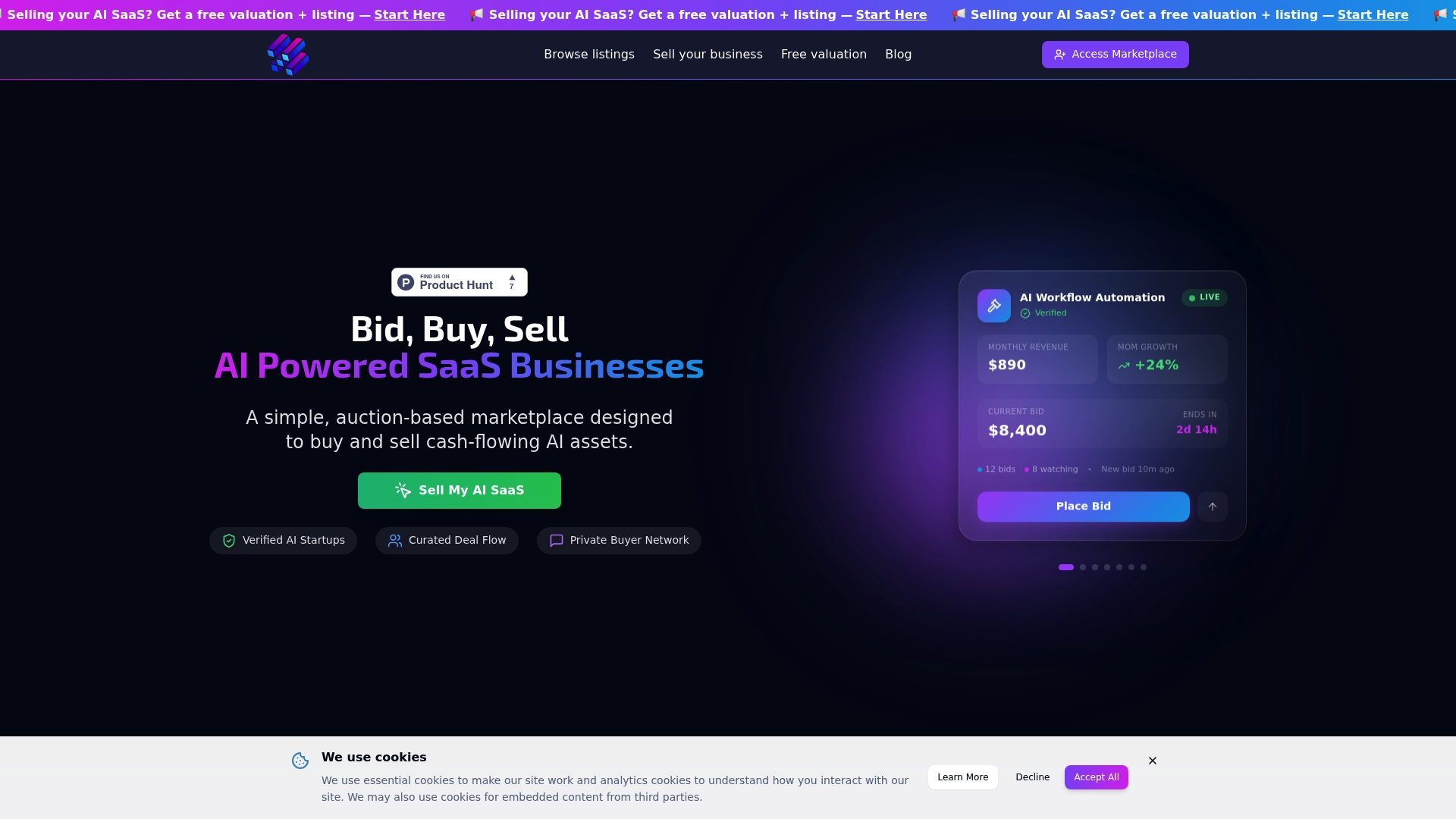
Start with the free listing if you are selling, or see the membership options if you are buying.
FAQ
What is a SaaS auction marketplace?
It is a platform where a founder lists an entire software business and buyers bid on it or make offers. The sale covers code, domain, customers and accounts, and closes through escrow. AIExchange.club does this for AI SaaS businesses specifically.
How much does it cost to sell an AI SaaS business on AIExchange.club?
Listing is free, and there are no monthly fees. The fee is a flat 10% success fee, paid only if the deal closes. A $75,000 sale carries a $7,500 fee.
How long does an AI SaaS acquisition take?
Our target is under 14 days from accepted offer to close, using the 6-stage pipeline and standardized contracts. Timing depends on how quickly the seller supplies documents and how deep the buyer’s due diligence goes.
Is the money safe during the deal?
Funds are held by Escrow.com, our escrow provider, until the assets are transferred. Contracts are signed in-platform, so both sides work from the same standardized documents.
Sources
Recommended
AI SaaS businesses for sale right now
Browse all AI businesses for sale →
AI Business Broker | Helping AI SaaS founders secure confidential exits | 2.16M in AUM
Comments (0)
Be the first to share your thoughts.


