
A good SaaS acquisition strategy for an AI product comes down to one rule: buy durable revenue, not a clever prompt. Decide what you are buying (cash flow, a customer base, a distribution channel or a team), test whether customers would stay if the underlying model got cheaper and better, and move the risks you cannot remove out of the price and into the deal structure. AIExchange.club is a marketplace for AI SaaS businesses: listing is free, the success fee is a flat 10% with no monthly fees, and every deal closes through escrow with standardized contracts. This guide is the strategy that sits around that process, for buyers and for founders preparing to sell.

TL;DR
- Define the thesis first: cash flow, customers, distribution or talent. Every screen that follows serves it.
- Rebuild recurring revenue yourself, then stress-test it against model costs, API terms and data rights.
- Price the baseline on revenue quality, then use holdbacks, seller notes or earnouts for the risk you cannot verify.
- Close with standardized contracts and escrow, and plan the first 90 days before you sign.
- Sellers who prepare clean revenue records and a transferable codebase get cleaner offers. Listing on AIExchange.club is free.
Why AI SaaS needs its own acquisition strategy
A generic software playbook assumes the product is the moat. In AI SaaS, the product often sits on top of someone else’s model. That changes what you are really buying.
AI is also where the deal activity is. Bain & Company’s 2026 software M&A report found that almost half of strategic tech deals in 2025 had an AI component, up from about one in four in 2024. Competition for good assets is rising, and so is the number of thin products that look good on a landing page.
The same report argues for a scenario-based approach: sketch two or three plausible AI futures, decide for each whether you would own or rent the capability, and revisit the view every quarter. For an indie buyer the version is simple. Ask what happens to this business if the model provider cuts prices, raises them, or ships the feature natively.

Step 1: Decide what you are buying
Write the thesis in one sentence before you open a listing. Four common ones:
- Cash flow. A small, stable tool you can run alone. Typical for indie hackers and solopreneurs buying micro-SaaS under $50k.
- Customers. A base you can cross-sell into, which suits agency owners acquiring tools for clients.
- Distribution. A Chrome extension, directory presence or audience that gets you users cheaply.
- Talent and code. A team or codebase that fills a gap in your product.
Bain notes that AI assets typically come with few customers, so revenue synergies run one way: the work is building a go-to-market plan that brings the acquired product to your existing customers, and the best acquirers use the pre-close period to design offerings, pricing and incentives. If your thesis is distribution, that plan is part of the strategy, not an afterthought.
Set a budget range and an operating limit as well. A buyer with 10 hours a week needs a product with low support load and few integrations, whatever the revenue.
Step 2: Screen for durable AI businesses
The central question is whether customers pay for the workflow or for the model’s output. A wrapper that returns a better answer than a free chatbot today may not tomorrow. Look for these signs of durability:
- Workflow depth. The tool sits inside a daily process, with saved data, templates, team accounts or approvals.
- Integrations. Connections to a CRM, helpdesk or storefront make switching painful.
- Distribution that is not the model. Search traffic, partnerships, a community or a marketplace listing the founder owns.
- Retention that holds. Customers stay through model updates and price changes.
A product that fails these is feature arbitrage: it earns while a gap exists. That can still be a fine cash-flow purchase, but at a price that assumes the gap closes. Our guide to how to buy an AI SaaS business walks through the full buying sequence.
Step 3: Rebuild the revenue and set a price
Never accept the headline MRR (monthly recurring revenue) from a listing. Rebuild it from payment processor exports and invoices:
- Remove setup fees, one-time services and usage spikes that will not repeat.
- Separate monthly plans, annual prepaid plans and any customer already signaling cancellation.
- Build a month-by-month bridge: starting revenue, new, expansion, contraction, churn, ending.
- Check concentration. If one or two customers make up a large share of revenue, the price should show it.
- Compute net revenue retention (NRR), the share of last year’s revenue you keep from the same customers after upgrades and cancellations. Flat MRR can hide high churn offset by new sign-ups, so look at it by customer cohort. Our page on net revenue retention has the formula and how it moves value.
Then price. Multiples depend on growth, retention, margin and size, and small AI products trade differently from venture-scale companies. Our SaaS valuation multiples guide breaks ranges down by category, and sellers can get an estimate from the AI SaaS valuation quiz.
For AI products, margin deserves extra attention. Inference costs (what the model provider charges per request) scale with usage, so a product with a flat subscription and heavy users can lose money on its best customers. Take the gross margin from the real provider invoices, not from the seller’s summary.
Step 4: Test the AI-specific risks
Standard diligence covers financials, customers, code and contracts. AI adds three more things to check.
Model and API dependency
Jones Day’s guidance for dealmakers says to map each AI component and check the status of the base model, the rights to training data, and the rights to prompts, logs and other artifacts. Practically, that means a dependency map: which provider, which model, which pricing tier, what happens if that model is retired.
Then run two stress tests on the seller’s numbers: inference cost 25% higher, and usage doubled from power users. If contribution margin collapses in either case, adjust the price or the structure. The 25% and 2x figures are a working rule of thumb we use for screening, not a legal standard.
Data rights and privacy
Check that the business has the right to use the data it trained or fine-tuned on, and that user data handling matches the privacy promises on its site. In the US that means mapping where the users are, because state privacy laws apply by residency. California’s CCPA is the best-known example. If the product handles health or regulated data, bring in a lawyer before you sign.
Code and security
Confirm the founder owns the repository, the domain, the model keys and the cloud accounts, and that every contractor assignment is in writing. Our guides on AI SaaS due diligence and technical due diligence give the item-by-item lists. For larger deals, forensic accounting support such as the financial reporting and forensic accounting work offered by KFN can help verify that the books match the bank statements.
Step 5: Structure the deal around what you cannot verify
If diligence leaves open questions, do not drop the price blindly. Move the risk into structure:
| Tool | What it does | Best used for |
|---|---|---|
| Cash at close | Pays the seller on transfer | Verified, stable revenue |
| Seller note | Seller finances part of the price | Aligning the seller with handover success |
| Earnout | Part of the price depends on future revenue | Uncertain retention or growth |
| Holdback in escrow | Part of the funds stays held after closing | Unresolved legal or data questions |
The split depends on your diligence confidence, and the details matter more than the percentages. Define the earnout metric precisely, name how disputes are settled, and state what the buyer may and may not do to the product during the earnout period. Our guides to financing a SaaS acquisition and earnout escrow setup cover amounts, release conditions and disputes.
Step 6: Close with escrow and standard documents
Most failed small deals fail at the end: one side moves first, or the paperwork is improvised. A standard sequence fixes that. Escrow.com, an independent escrow provider, describes its process for domains and websites like this: the buyer pays Escrow.com, which secures the payment, then releases the funds to the seller once the transfer is verified or the inspection period ends. Neither side has to trust the other with money or assets.
On AIExchange.club every deal moves through a six-stage pipeline: kickoff call, letter of intent (LOI), due diligence, asset purchase agreement, escrow and closing. Documents are generated from standardized contracts and signed in the platform with DocuSeal. Funds are held by Escrow.com, and the target close time is under 14 days. Our closing checklist lists what to have ready at each stage, and business acquisition steps shows the order from first call to close.

Step 7: Plan the first 90 days before you sign
Write the post-close plan during diligence, not after. A workable shape:
- Days 1 to 30: stabilize. Move accounts and keys, capture the founder’s knowledge, keep support response times where they were, and change nothing customers can see.
- Days 31 to 60: fix economics. Switch to cheaper models where quality allows, review pricing against inference costs, and close reliability gaps.
- Days 61 to 90: grow. Add integrations, retention features and the acquisition channels that pay back on a margin basis.
Bain’s advice for larger AI deals applies at small scale too: these acquisitions are about people. If the founder is the only one who understands the prompts and the customers, negotiate a paid transition period and a clear handover. Our post-acquisition handover plan has the checklist. If you plan to add AI capability across a wider team or portfolio, an AI readiness assessment can help you set governance before you scale.
If you are the seller: prepare like a buyer would
Everything above is what the person across the table will do to your business, so do it first.
- Keep a clean monthly revenue bridge tied to payment processor records.
- Separate recurring revenue from services and one-off income.
- Document your model providers, keys, costs and the prompts that matter.
- Put contractor IP assignments in writing and move code into an organization account you can transfer.
- Know your NRR, churn and top-customer share before a buyer asks.
- Decide how long you will help after closing.
Buyers pay more when they can verify your numbers quickly, and they ask for less protection when the file is clean. Listing is free, and confidential listings are protected by NDA, so a first look does not expose your customers. We verify revenue and code quality as part of the process.
Perspective: why structure beats negotiation in small AI deals
Most small AI deals do not fail on price. They fail because nobody agreed on who moves first, what gets verified and what happens if revenue drops in month two.
That is why we built AIExchange.club around a fixed sequence: kickoff, LOI, due diligence, APA, escrow, closing. The contracts are standardized and signed in the platform, and the money sits with Escrow.com until the transfer is done. A buyer purchasing a $30k wrapper and a founder selling a side project should not need a six-figure retainer to get that.
Our pricing follows the same logic. Listing is free, there are no monthly fees for sellers, and we charge a flat 10% success fee only when a deal closes. We earn when you do. For AI SaaS in particular, we think the right default is verify first, then structure the leftover risk, not haggle until someone gives up.
Phillip
Start your search or your listing
If you are buying, browse AI SaaS businesses on the AIExchange.club marketplace, make an offer or join a live auction. Buyers can use Marketplace Membership at 49 USD per month or 399 USD per year, and the success fee on a closed deal is a flat 10%.
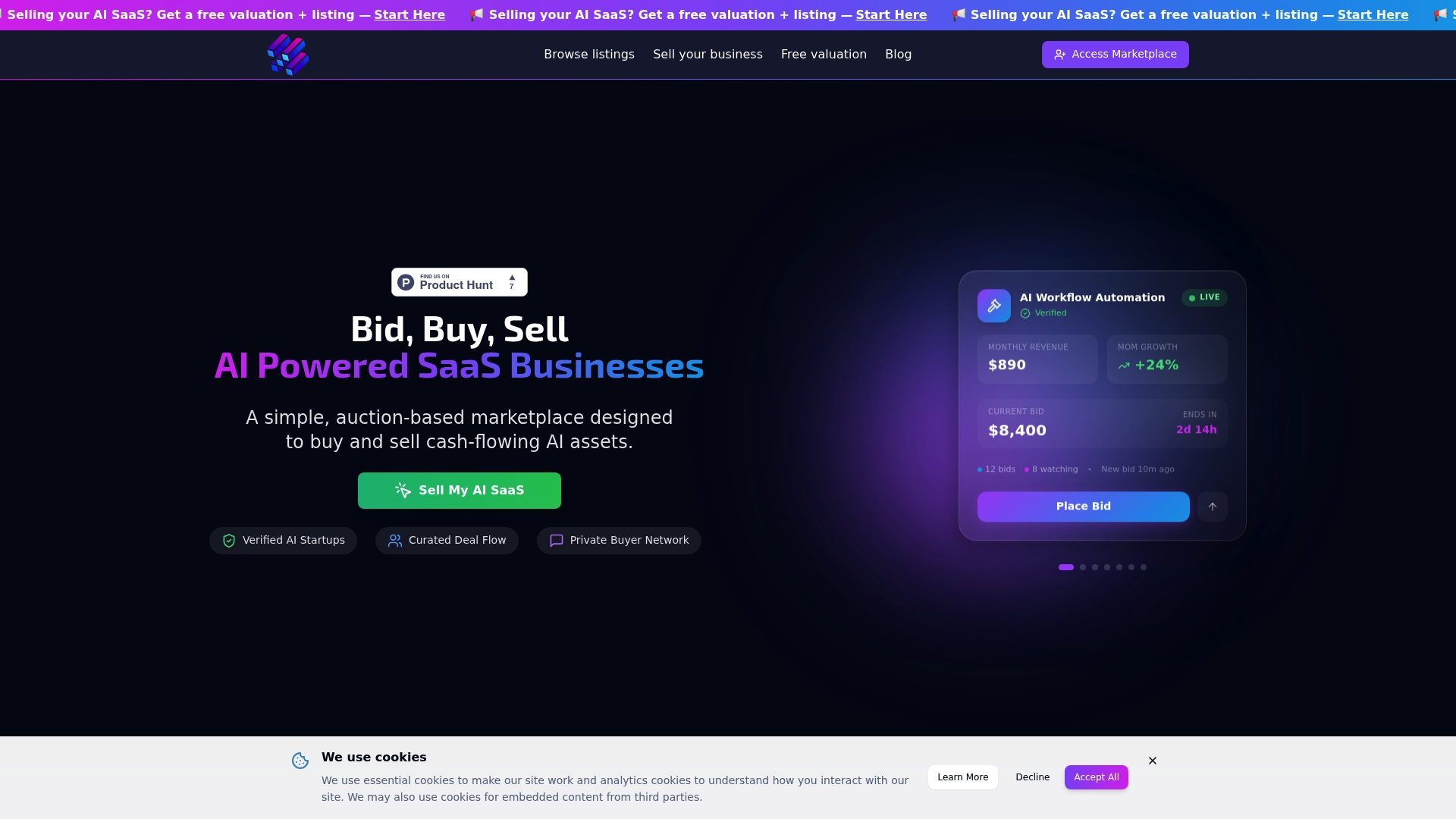
If you are selling, you can start a free listing in categories including automation, chatbots, content creation, customer support, data and analytics, developer tools, marketing tools and productivity. You pay the flat 10% success fee only when the deal closes, with no listing fees and no subscriptions on the seller side. For larger or more complex exits, there is also Boutique AI M&A Advisory.
FAQ
How long should an AI SaaS acquisition take?
That depends on how organized both sides are. On AIExchange.club the target close time is under 14 days once an offer is accepted, because contracts are standardized and escrow is built into the pipeline. Deals slow down when the seller cannot produce clean revenue records or the buyer’s financing is not lined up.
What is a safe first AI SaaS acquisition for a beginner?
A small business with steady paying customers, low support load and a single, well-documented model provider. Rebuild its revenue yourself and run the cost stress tests before you make an offer. Keep the first purchase small enough that a bad month does not end the project.
Does the marketplace only handle AI SaaS?
Yes. AIExchange.club is for AI SaaS businesses, from wrappers and Chrome extensions to agents, analytics and vertical tools. That focus is why the diligence steps cover model dependency, data rights and inference costs.
What does it cost to sell?
Listing is free. The success fee is a flat 10%, charged only when the deal closes, with no monthly fees, listing fees or upsells for sellers.
AI SaaS businesses for sale right now

AI Business Broker | Helping AI SaaS founders secure confidential exits | 2.16M in AUM
Comments (0)
Be the first to share your thoughts.


