
AI deal matching takes what a buyer wants (budget, category, revenue range, tech stack, risk appetite) and what a seller has (revenue, churn, code, customers), then ranks the pairs most likely to close. It narrows a big pool to a short list. It does not replace diligence, a signed contract or escrow. On AIExchange.club, a marketplace for AI SaaS businesses, matching is the front door, and every deal still runs through a structured pipeline with standardized contracts and escrow.

TL;DR
- AI deal matching scores buyers against listings on criteria like category, size, growth and deal preferences, then returns a ranked short list.
- Its real value is reach: it can surface targets a buyer would never have searched for. McKinsey’s M&A example went from about 1,600 viable targets to 40 priority ones.
- A match is a lead, not a verdict. Verify revenue, code, data rights and model dependencies before you sign anything.
- Keep confidential deal data out of third-party AI tools that train on inputs, or you risk breaching an NDA.
- On AIExchange.club, listings are free, the success fee is a flat 10% with no monthly fees, and deals close through escrow with standardized contracts.
What AI deal matching actually means
Traditional deal sourcing is manual. A buyer scrolls listings, emails founders, and guesses at fit. A seller posts a listing and waits to see who shows up. Both sides burn time on conversations that were never going to close.
AI deal matching changes the first step. The buyer states a thesis in structured fields or plain language: “profitable AI writing tool, under $50k, low support load, no dependence on a single model vendor.” The system turns that into a search, compares it against listing attributes, and returns a ranked list with reasons attached. For sellers, the same logic runs in reverse: which buyers have a track record or stated preference that fits this business?
Three things make this useful in AI SaaS specifically:
- The category is fragmented. Wrappers, agents, Chrome extensions, vertical tools and analytics products look alike on the surface and differ sharply underneath. Matching on structured attributes beats keyword browsing.
- Buyers are diverse. An indie hacker with a $20k budget, an agency owner who wants a tool for clients and a micro-PE fund looking for cash flow all want different things from the same listing.
- Time matters. A founder who is burnt out on a side project wants a fast, qualified conversation, not forty tire-kickers.
How matching works under the hood
Systems differ, but the logic tends to follow the same four steps.
1. Describe the business and the buyer in structured terms
On the seller side, the system needs facts: category, monthly recurring revenue, growth trend, churn, customer concentration, tech stack, which AI models the product calls, and how much of the work the founder does personally. On the buyer side, it needs budget, preferred categories, geography or time zone, experience level, and how hands-on they want to be.
2. Score fit across several dimensions
Good matching does not collapse everything into one opaque number. The useful version scores separate questions: Does the category fit? Does the price fit the budget? Is the business operable by this buyer? Does it complement something the buyer already owns? A buyer who already runs an AI SEO tool may weigh a content-generation product differently from a first-time acquirer.
3. Rank and explain
A ranked list with no reasoning is hard to trust. A ranked list that says “matches your category and budget, but revenue depends on one customer” lets you decide quickly. Insist on reasons, whatever platform you use.
4. Flag what is missing
The most honest thing a matching system can do is say what it does not know. Missing churn data, unverified revenue or an unclear code license should lower confidence, not be quietly ignored.
Why it helps: reach, speed and focus
The strongest published evidence for the benefit is about reach. McKinsey’s analysis of generative AI in M&A describes how AI can scan broader sets of structured and unstructured data to find targets a company would not otherwise have on its radar. In its worked example, the process identified about 1,600 viable targets and prioritized 40, most of which had not been considered before. That example comes from corporate M&A, not micro-SaaS, so treat it as an illustration of the mechanism rather than a promise of results on any marketplace.
For a buyer of a small AI SaaS business, the practical translation is simple:
- You see businesses you would not have searched for by name or category.
- You spend your first call on a business that already passed your basic filters.
- You compare options on the same criteria instead of whatever each listing happened to emphasize.
For a seller, the translation is:
- Your listing reaches buyers whose stated preferences fit your category and size.
- You spend less time on unqualified inquiries.
- Confidentiality stays intact, because you can share detail with matched, NDA-bound buyers rather than with everyone.
If you are selling, the NDA guide for a business sale covers what to settle before any buyer sees your numbers.
Where AI matching falls short, and how to use it well
Matching is only as good as the data behind it and the judgment applied to its output. Law firms and professional advisers who write about AI in deals keep returning to the same cautions, and they are worth building into your process.
Confidentiality leaks through the tools
The most practical risk is not the match. It is what you paste into the tool. Baker Donelson warns that uploading target data into third-party AI tools can breach nondisclosure agreements if the tool uses inputs to train or improve its models. It also recommends an AI use policy that names permitted tools, what data may be uploaded and what approvals are required, plus a documented human verification step for AI-generated analysis.
If you are a buyer who received a seller’s financials under NDA, do not drop them into a general-purpose chatbot to “summarize.” Check the tool’s data terms first, or keep the work in a closed environment.

Outputs can be confidently wrong
Koley Jessen notes that AI can accelerate diligence but can miss nuance, introduce errors and misread context, so human judgment stays necessary. A fit score built on a mislabeled category or a stale revenue figure is a bad guide. McKinsey makes a related point: as models improve, people may disengage and miss issues until it is too late, so organizations should keep people at the center of the work.
An AI label is not value
Skadden’s 2026 guidance for buyers of AI businesses says the label itself proves nothing. Buyers should validate proprietary data rights and traceability, model performance under stress, compute economics and key-person concentration. That applies directly to a thin wrapper around a third-party model: a high match score does not tell you whether the margin survives the next API price change.
Claims about AI must be substantiated
The FTC’s summary of its AI work says it has taken enforcement actions requiring companies to substantiate claims about AI safety, bias and efficacy. If a listing makes strong claims about what its AI does, a buyer should treat those claims as something to test, not accept.
What to verify before you act on a match
Treat every match as a hypothesis. This checklist works for either side of the table.
| Area | Buyer asks | Seller prepares |
|---|---|---|
| Revenue | Do payout records and bank statements agree with the listing? | Clean exports from the payment processor and accounting records |
| Code and stack | Who owns the repository, and which third-party models and APIs does the product depend on? | Repository access plan, dependency list, license inventory |
| Data and training | Where did the training or fine-tuning data come from, and do rights and consents cover it? | Documentation of data sources and permissions |
| Customers | How concentrated is revenue, and what does churn look like by cohort? | Cohort and retention data |
| Key people | What happens if the founder steps away? | Documented processes and a handover plan |
| Identity | Is the seller who they say they are and the legal owner? | Proof of ownership and identity |
The American Bar Association’s guidance on AI-enabled targets says legal diligence must be tailored to the specific AI tools used, including confirming rights to use AI-generated outputs and evaluating liabilities from third-party models. It also tells buyers to look at how the AI was trained, the source of the training data and any associated rights, disclosures or consents.
Haynes Boone’s 2026 guidance lists the risks that tend to show up in AI deals: confidential-information leakage, privacy and cybersecurity problems, IP disputes, inaccurate outputs, bias, regulatory noncompliance, vendor lock-in and open-source contamination. It adds that these belong in the transaction documents and diligence, not in a generic IT checklist. That is why a standardized purchase agreement with clear representations and warranties matters. Our guide to representations and warranties in an AI SaaS sale shows how those protections are framed.
Privacy promises travel with the business, too. When the FTC reviewed the proposed Facebook and WhatsApp deal, it notified both companies that failing to honor WhatsApp’s privacy promises could violate Section 5 of the FTC Act. A small AI SaaS product with user data is a smaller version of the same question: what did the privacy policy promise, and can the buyer keep those promises?
For the detailed walk-through, use these:
- AI SaaS due diligence: what to verify before you buy
- Technical due diligence for AI SaaS acquisitions
- Seller identity verification for AI SaaS deals
How matching fits into the AIExchange.club deal flow
AIExchange.club is a marketplace for AI SaaS businesses only. That narrow scope is deliberate: it lets matching work with attributes that mean something in this category, such as the model providers a product depends on or whether it is a wrapper, an agent or a vertical tool.
Here is how the pieces connect:
- Sellers list for free. Listing a business costs nothing. Fees come only if a deal closes.
- Buyers browse the marketplace, submit offers or join live auctions. Matching and Slack community notifications point buyers to listings that fit what they said they want.
- The deal runs through a 6-stage pipeline: Kickoff, LOI, Due Diligence, APA, Escrow, Closing. Contracts are generated and signed in-platform.
- Funds are held in escrow. Deals close through escrow with standardized contracts, using Escrow.com as the escrow provider. Our target close time is under 14 days.
Buyers who prefer a curated route can look at the private AI acquisition network. If you are weighing which listings to pursue, our buyer’s checklist for AI businesses for sale and the step-by-step guide to buying an AI SaaS business show what to prioritize after the match.
Tips for buyers
- Be specific in your criteria. “Any profitable AI tool” produces vague matches. Name categories, a budget ceiling, the revenue band and how much work you want to do each week.
- Say what you will not accept. Heavy dependence on one model vendor, concentrated revenue or a founder who is the only support channel can be deal-breakers. State them.
- Read the reasons, not just the rank. A top match with a flagged risk can be worse for you than the third match with none.
- Run your own checks anyway. A match tells you where to look first. Diligence tells you whether to buy.
Tips for sellers
- Complete every field. Missing data lowers confidence and can push you down a ranking. Clean revenue records and clear descriptions of the stack help.
- Be accurate about the AI. Say which models you use, what you fine-tuned and where data came from. Buyers will test it.
- Protect your numbers. Use the NDA step before sharing detail, and keep sensitive material out of public AI tools.
- Think about the sale format. Offers suit steady businesses; auctions can suit products with several interested buyers. Our piece on AI SaaS auction strategies goes deeper.
Promo: list, match and close in one place
If you have an AI SaaS product that earns revenue, listing it on AIExchange.club is free, and the platform’s matching puts it in front of buyers whose preferences fit. The success fee is a flat 10%, paid only when a deal closes, with no monthly fees, no listing fees and no upsells. Deals close through escrow with standardized contracts.
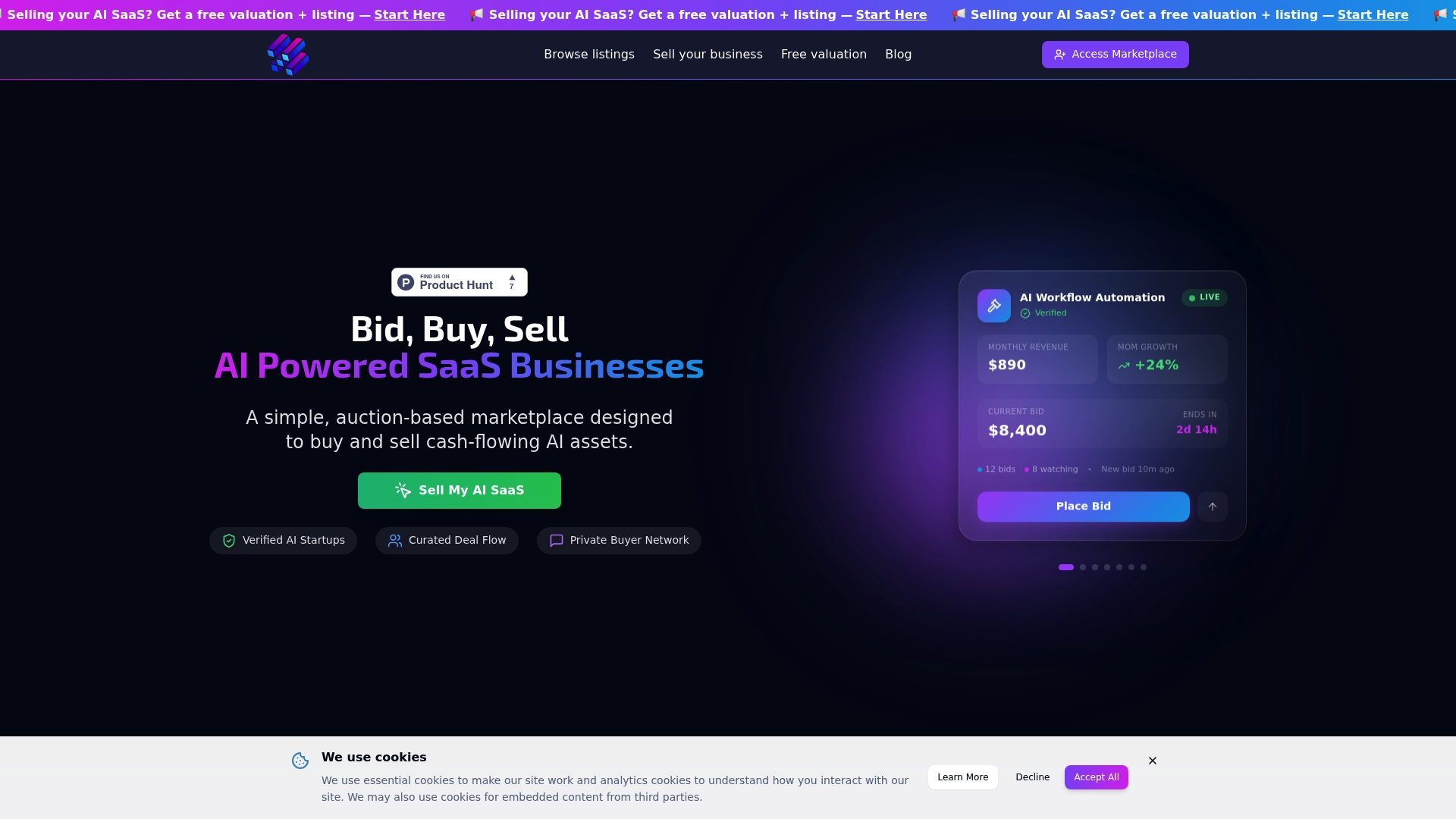
Sellers can start a free listing across categories such as automation, chatbots, content creation, customer support, data and analytics, developer tools, marketing tools and productivity. Buyers who want full marketplace access can see membership options: $49 per month or $399 per year. If you want hands-on help, there is also boutique AI M&A advisory.
Perspective
We built matching around one belief: most small AI SaaS deals die in the first two weeks, not because the business is bad, but because the wrong people found each other.
A founder with a wrapper earning a few thousand dollars a month does not need a six-figure broker engagement. A buyer with a $30k budget does not need to scroll through hundreds of listings that were never meant for them. Matching handles the sorting, and the pipeline handles the rest: a kickoff call, a letter of intent, due diligence, signed agreements, escrow and closing.
We would rather keep the price simple than clever. Listing is free. The fee is a flat 10% when a deal closes. No monthly charge for sellers, no hidden extras. That way our incentive lines up with yours: we earn when you close.
We also think a match should be treated as a starting point. The best buyers on our marketplace test the code, the revenue and the data rights, and the best sellers expect them to. Escrow and standardized contracts exist so that both sides can be rigorous without it turning into a fight.
Phillip
FAQ
Is AI deal matching the same as using a broker?
No. Matching is software that ranks likely fits from structured data, while a broker is a person who negotiates and manages a deal. On AIExchange.club, self-serve and assisted closing are both available, so you can use matching and the pipeline on your own or add advisory support if you want it.
Does AI deal matching guarantee a sale?
No. It raises the odds that you talk to relevant counterparties, but price, diligence findings and terms still decide whether a deal closes. Treat a high match score as a reason to start a conversation, not as a prediction of the outcome.
Is it safe to put my business data into AI tools while looking for a deal?
It depends on the tool and on your NDA. Law firm guidance warns that uploading target data to a third-party AI tool can breach nondisclosure agreements if the tool uses inputs for training. Check the tool’s data terms, follow your NDA, and ask a business attorney if you are unsure.
What does it cost to be matched on AIExchange.club?
Listing a business is free. The success fee is a flat 10% and is paid only when a deal closes, with no monthly fees. Buyers who want full marketplace access can choose a membership at $49 per month or $399 per year.
What kinds of businesses does matching cover?
The marketplace is for AI SaaS businesses. That includes AI writing tools, image and video generators, agents, chatbots, analytics, SEO tools, coding tools, customer support tools, GPT-powered products and Chrome extensions, among other categories.
Sources
- Gen AI in M&A: A new opportunity for growth, McKinsey
- The Deal Team’s New Colleague, Baker Donelson
- Balancing AI Efficiency with Human Judgment in M&A Due Diligence, Koley Jessen
- M&A in the AI Era, Skadden 2026 Insights
- The FTC is on the Front Lines of AI Innovation & Regulation, FTC
- Diligencing AI-Enabled M&A Targets, American Bar Association
- Addressing AI Risks in Merger and Acquisition Transactions, Haynes Boone
- FTC Notifies Facebook, WhatsApp of Privacy Obligations, FTC
Recommended
AI SaaS businesses for sale right now
Browse all AI businesses for sale →
AI Business Broker | Helping AI SaaS founders secure confidential exits | 2.16M in AUM
Comments (0)
Be the first to share your thoughts.


