
A confidential business listing advertises a company for sale without naming it. Buyers see a described business (category, revenue range, age, business model) and learn the name, URL, customers and code only after they identify themselves and sign a nondisclosure agreement (NDA). On AI Exchange Club, which is a marketplace for AI SaaS businesses, listing is free, the success fee is a flat 10% with no monthly fees, and deals close through escrow with standardized contracts.

This guide covers what a seller can safely put in an anonymous listing, what an NDA should say, when identity gets disclosed, and how to keep information protected through due diligence.
TL;DR
- A confidential listing shows the shape of the business (category, revenue range, age, model) and hides anything that identifies it, until a buyer signs an NDA.
- Identifying details come in combinations: a niche, a launch year and an exact revenue figure can name you even without a company name. Generalize them together.
- An NDA should define confidential information, limit who can see it and for what purpose, set a term, and require return or destruction of materials.
- For AI SaaS, the sensitive items go beyond financials: source code, prompts, model configuration, datasets and customer data all need staged disclosure.
- On AI Exchange Club, listings are free, the success fee is a flat 10% with no monthly fees, and deals close through escrow with standardized contracts.
What a confidential business listing is
A confidential listing (sometimes called a blind listing or teaser) is a public marketing page that describes a business without disclosing who owns it. Its job is to give a qualified buyer enough to decide whether to ask for more, while keeping customers, competitors, employees and platform partners from learning that the business is for sale.
The reason sellers use one is practical. If customers hear that an AI tool is changing hands, some will wonder about support and pricing. If a competitor hears it, they can use it in sales conversations. If an API vendor or a contractor hears it, they may renegotiate. A law firm publication on sale confidentiality, Robinson Bradshaw’s guide, makes the same basic point: protecting both company information and the fact of the transaction is critical in a sale.
The search terms people use for this overlap, and they describe stages of one process:
- Anonymous startup listing: the public teaser, with no name, URL or logo.
- Listing under NDA: the gate between the teaser and the sensitive details.
- Anonymous buyer mode: the buyer-side mirror. A buyer browses and asks questions without exposing who they are or what they are looking for, then identifies themselves when a seller requires it. Sellers usually want to know who is asking before they release anything meaningful, so anonymity for buyers typically ends at the NDA step.
What you can show in an anonymous listing
The goal is credibility without identifiability. Research on confidential listings points to a consistent set of safe fields: industry, general geography, business model, year founded, employee count range, customer profile, revenue and earnings ranges, what is being sold, and the process for engaging further. Another practitioner summary adds ownership involvement, operational strengths, growth opportunities and the reason for sale as typical content.
For an AI SaaS business, a workable teaser looks like this:
| Field | Safe to show | Keep back until NDA |
|---|---|---|
| Category | “AI customer support tool” | Product name, tagline |
| Revenue | A range or rounded trailing figure | Exact monthly revenue, payment processor exports |
| Age | Approximate (“2+ years”) | Launch date, public changelog |
| Customers | Segment (“small ecommerce teams”) and a count range | Customer names, logos, contracts |
| Tech | Stack type (“web app on a major LLM API”) | Repository, prompts, model configuration |
| Team | “Solo founder, part-time contractor” | Names, profiles |
| Traffic | Channel mix in percentages | Domain, analytics access |
| Reason for sale | “Founder moving to a new project” | Personal details |
The column on the right is not a list of things you will never share. It is the order in which you share them.
Why combinations identify you
The name is rarely what gives a business away. A guide on writing confidential listings advises avoiding combinations of details that make a company easy to identify, such as unique customer names, distinctive contracts, proprietary technology or specific photographs. In a small market like micro-SaaS, “AI resume tool, launched spring 2024, 4,000 users, $9,000 monthly revenue, sold via a Chrome extension” may point to exactly one product.
Before publishing, run a simple test. Imagine a competitor, a customer or a former contractor reading the teaser. Would any of them recognize the product? If yes, widen the ranges, drop the launch month, and describe the channel rather than naming it. A practitioner article on teasers puts the stakes plainly: if a buyer can identify the business from the teaser alone, confidentiality is compromised before any NDA exists.
A few habits that help:
- Use revenue bands and round to a meaningful but not exact figure.
- State the year, not the month, and say “over two years” instead of the launch date.
- Describe integrations by type (“a major LLM API”) rather than naming obscure partners.
- Leave out screenshots, UI copy, unusual feature names and any quote from a customer.
- Check that your public listing text does not appear verbatim on your own site, in your launch posts or in app store descriptions.
How listing under an NDA works
An NDA is the mechanism that lets you move from a general description to real data. The typical sequence is: the buyer sees the teaser, requests more, identifies themselves, signs the NDA, and then receives the next layer of information, such as the business name, a financial summary and a high-level product walkthrough.
What the document needs to contain matters more than the fact that one exists. According to a U.S. law firm guide to NDAs in business purchases, a balanced agreement defines “Confidential Information” clearly and excludes information that is public through no fault of the buyer, already known to the buyer, independently developed, or received from an unrestricted third party. The same guide notes that most NDAs impose obligations for a fixed period, commonly one to five years, while trade secrets should be protected for as long as they remain legally protectable.
For sellers, that last point has weight. Source code, prompt libraries and training data are trade secret candidates, and a short fixed term on an NDA may not fit them. Ask for trade secret carve-outs that last as long as the protection does.
What the buyer should review before signing
Serious buyers read the NDA. The same law firm series lists what to check: the definition of confidential information, permitted purpose and recipients, the duty of care, term and survival, return or destruction requirements, and any non-solicitation clauses. It also warns that an overbroad or one-sided NDA can constrain a buyer’s later operations, expose them to trade secret claims, or bar them from other opportunities in the same market, so a buyer should treat it with the same care as the purchase agreement (see the Mondaq republication).
This is why standardized terms help both sides. When the NDA is the same document for every deal, buyers do not have to renegotiate it each time and sellers do not have to explain why theirs is unusual. Our guide to the NDA for a business sale walks through what to cover before buyers see your numbers.
Checklist for sellers
- The agreement names the specific purpose: evaluating a possible acquisition, nothing else.
- Recipients are limited to the buyer’s named advisors and financing sources, each bound by the same duties.
- The fact that the business is for sale is itself confidential.
- Materials must be returned or destroyed on request.
- Non-solicitation of your customers and contractors is covered, in a form a buyer can reasonably accept.
- Trade secrets are protected beyond the general term.
This is general information, not legal advice. If your business has employees, contractors with IP assignments, or enterprise customers with confidentiality clauses of their own, have a business attorney in your state review the NDA before you rely on it.
What counts as confidential in an AI SaaS sale
A general business sale protects financials, customer lists and contracts. An AI SaaS sale adds technical assets that are often worth more than the revenue. An overview from an Australian law firm on confidentiality clauses for AI software lists the categories that typically count: source code and architecture, model weights and tuning methods, training and evaluation datasets, prompts and guardrails, benchmarking results, security controls and infrastructure details, roadmaps and pricing, API documentation, and any customer data or usage analytics that gets disclosed. It is Australian guidance, but the categories map directly onto a U.S. micro-SaaS.
A practical tiering for a seller:
Tier 1, public teaser (no NDA). Category, revenue range, age, model, customer segment, general stack type.

Tier 2, after NDA. Business name and URL, monthly revenue and churn summaries, acquisition channels, cost structure including API spend, support volume, and a product demo.
Tier 3, after a serious offer or LOI. Read access to payment processor and analytics dashboards, customer-level data in anonymized form, code review access, prompt and configuration review, vendor contracts.
Tier 4, before closing. Credentials, repositories, domain and account transfers, and customer contact where appropriate.
The staged approach is also how we describe due diligence. If you are preparing for it, our data room setup guide for an AI SaaS sale shows how to organize each tier, and the technical due diligence guide shows what a buyer will look at in the code and model layer.
When identity gets disclosed
There is no single universal moment. The usual rule is that disclosure follows commitment: each layer of identity or data is released only after the buyer has given something in return.
- Teaser stage. Nothing identifying. Buyers can browse and ask general questions.
- NDA stage. The buyer is identified and bound. The seller can now release the name, the URL and summary financials.
- Offer and LOI stage. A buyer who submits an offer is signalling real intent, and the parties align on price and structure. Deeper data becomes appropriate.
- Due diligence. Access to systems, code and customer data under the NDA and any additional data-handling terms.
- Signing and closing. The asset purchase agreement is executed and funds move through escrow.
Sellers should also verify who is on the other side. Identity runs in both directions: a seller wants to know the buyer is real, and a buyer wants to know the seller owns what they are selling. Our piece on seller identity verification for AI SaaS deals covers the buyer’s side of that check.
Reducing confidentiality risk during marketing and diligence
Most leaks do not come from the listing. They come from what happens after a buyer starts looking.
Keep the teaser honest and generic
A vague teaser that attracts the wrong buyers wastes time, while an overly specific one risks exposure. Use ranges, describe the model, and let the NDA gate everything else.
Control who the buyer shares with
The NDA should name permitted recipients. Buyers often bring in an accountant, a developer for a code review, or a lender. Each should be bound, and the buyer should be responsible for their compliance.
Watch the AI tooling on the buyer side
This one is new and specific to our category. A U.S. law firm analysis of AI and M&A NDAs points out that some AI tools retain user inputs for model improvement or internal analytics, which can conflict with an NDA’s requirements to use information only for evaluating the deal, avoid disclosure to unauthorized third parties, and return or destroy materials on request. A buyer who pastes your code or financials into a consumer chatbot may be in breach without meaning to be.
For an AI SaaS seller, add a clause that addresses it: materials may not be uploaded to any third-party AI service that retains or trains on inputs, unless the seller approves the tool in writing.
Stage the data
Do not hand over a full data room on day one. Release by tier, log who accessed what, and use read-only or watermarked views where possible.
Plan your own announcement
Decide in advance when and how you will tell customers, contractors and any key vendors. For a solo founder this is often a short email sent at or just before closing, with a transition plan attached.
> Perspective
We built the confidential listing around a simple belief: an indie founder should be able to test the market for an AI SaaS business without announcing it to their customers.
Most of the products sold here are small, often run by one person, and that is exactly why identification is so easy. A niche, a launch year and a revenue figure are enough. So we treat confidentiality as something the platform enforces, not something each seller has to improvise: listings are protected with an NDA, contracts are standardized, and every deal runs through the same six stages from kickoff to closing.
We also think confidentiality and speed are not opposites. When the NDA, the purchase agreement and the escrow process are the same every time, neither side spends days negotiating paperwork, and the target close time stays under 14 days. And because the success fee is a flat 10% paid only when a deal closes, a seller can list, explore interest and walk away without having paid anything.
If you are on the fence, list and see who asks. That costs nothing.
Phillip
How a confidential listing works on AI Exchange Club
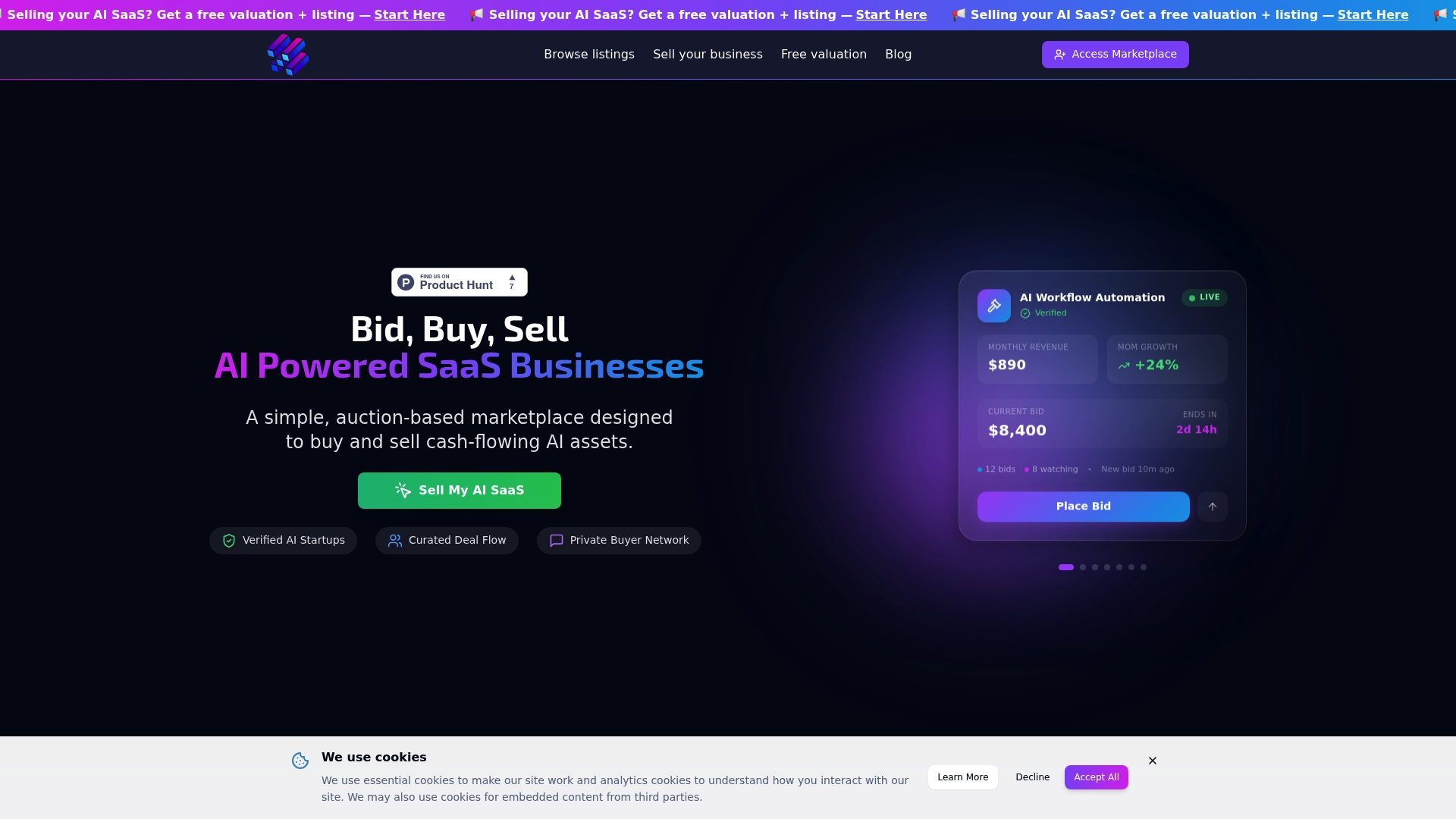
AI Exchange Club is a curated marketplace for buying, selling and auctioning AI SaaS businesses. The listing process is built around confidentiality protection via NDA.
Here is what that means in practice:
- Listing is free. There are no listing fees and no subscription for sellers.
- The success fee is a flat 10%, charged only when a deal closes. There are no monthly fees, and no upsells.
- Deals close through escrow with standardized contracts. Legal documents are generated and signed in the platform, and funds are held by Escrow.com.
- A six-stage pipeline guides each accepted offer: Kickoff Call, LOI, Due Diligence, APA/ATA, Escrow, Closing.
- Categories include automation, chatbots, content creation, customer support, data and analytics, developer tools, marketing tools and productivity.
Buyers can browse the AI SaaS marketplace, submit offers or join auctions. Marketplace Membership for buyers is $49 per month or $399 per year, and full details are on the pricing page. Buyers who want to be matched to listings before they are public can look at our private acquisition network.
Ready to list without exposing your business?
If you own an AI SaaS business that earns revenue, you can start with a free listing and decide later how much to disclose and to whom. Not sure what the business is worth? Our valuation quiz gives you a data-backed starting point first, and you can start your listing in the category that fits. If you want hands-on help running a more complex sale, our boutique M&A advisory is available too.
What buyers should expect from an anonymous listing
If you are on the buying side, a teaser will tell you less than you want. That is by design. Read it for fit, not for proof.
- Use ranges as filters. If a listing shows revenue in a band, decide whether the low end still works for you.
- Expect the NDA first. Read it before signing, using the checklist above. Pay attention to who may see the material, how long the duties last, and what happens to your own future projects in the same category.
- Ask about the verification path. What will be verified after the NDA: revenue, traffic, code? Our AI SaaS due diligence guide and buyer’s checklist cover what to look at.
- Use auctions with a plan. If a business goes to a live auction, set your ceiling in advance. See our notes on AI SaaS auction strategies.
- Handle materials carefully. Do not upload seller documents to a public AI tool, and keep them off shared drives.
FAQ
What is a confidential business listing?
It is a public listing that describes a business for sale without naming it. Buyers see category, revenue range, age and model, and they receive identifying details only after signing an NDA. The purpose is to test the market without alerting customers, competitors or vendors.
Can a buyer stay anonymous too?
A buyer can usually browse and ask general questions without revealing everything, but sellers typically want to know who is asking before they release identifying information or financials. Expect the NDA step to be where the buyer is identified. Buyers who prefer discretion can use a private network to be matched to listings.
What should an NDA for selling an AI SaaS business cover?
It should define confidential information, limit the permitted purpose and recipients, set a term that does not cut off trade secret protection, and require return or destruction of materials. For AI SaaS it is worth adding limits on uploading code, prompts or data to third-party AI tools that retain inputs. Have a business attorney review it before you rely on it.
Does it cost anything to list?
No. Listing on AI Exchange Club is free. We charge a flat 10% success fee only when a deal closes, with no monthly fees, and deals close through escrow with standardized contracts.
Is this only for AI SaaS?
Yes. The marketplace is for AI SaaS businesses, including AI wrappers, agents, chatbots, content tools and other revenue-generating AI software products.
Sources
- Robinson Bradshaw: Keeping Secrets Secret, Confidentiality in the Sale of a Business
- Harris Sliwoski: Buying a Business in the U.S., Part 3, Nondisclosure Agreements
- Mondaq: Buying a Business in the U.S., Part 3, Nondisclosure Agreements
- Sprintlaw: Confidentiality Clauses for AI Software
- KJK: AI and M&A NDAs, Managing Artificial Intelligence Risks in Confidentiality Agreements
Recommended
AI SaaS businesses for sale right now

AI Business Broker | Helping AI SaaS founders secure confidential exits | 2.16M in AUM
Comments (0)
Be the first to share your thoughts.


