
Micro PE deal sourcing is the work of building a steady pipeline of small companies you could buy, then filtering that pipeline until a few real conversations remain. For AI SaaS and micro-SaaS, the practical answer is a mix: direct outreach to founders who are not for sale yet, relationships and communities, and a marketplace where sellers have already decided to sell and the paperwork is standardized. This guide shows how to run those channels as one system, how to screen leads fast, and what to track so a lead turns into an offer.

TL;DR
- Sourcing is a pipeline problem. Treat it as stages with counts, not as a hunt for one perfect deal.
- Search funds have traditionally split their time roughly 80% proprietary and 20% intermediated. Small software buyers can run a similar mix.
- Screen on a written buy box first: revenue range, churn, founder dependence, tech stack, and what you would change after closing.
- Listings on AIExchange.club are free for sellers. The success fee is a flat 10% with no monthly fees, and deals close through Escrow.com with standardized contracts. The marketplace is for AI SaaS businesses.
- Budget for time. The slowest part of any search is the search itself.
What deal sourcing means at the micro end
In traditional private equity, deal sourcing means identifying, evaluating and pursuing companies that fit a fund’s objectives. Large funds hire people just for this. At the micro end, the buyer is often one person: a search fund principal, a solo acquirer with a small pool of capital, a small group of operators, or an agency owner who wants to own the tools it resells.
That changes the job. You have no analyst team, so every hour you spend on a bad lead is an hour taken from a good one. Sourcing at this scale comes down to three questions:
- Where do I find companies that match my criteria?
- How do I get a first conversation with the owner?
- How do I decide quickly whether the lead deserves diligence?
The rest of this article answers those in order.
How long a search takes, and what that means for your plan
Before choosing channels, set expectations. The Stanford Graduate School of Business Center for Entrepreneurial Studies reports that the average searcher spends 19 months on the search phase, and its guidance is that the biggest enemy of a searcher is time. The same paper says a searcher should not make a big deal out of the letter of intent (LOI): successful searchers often sign LOIs in the first year, and treat an LOI as a way to start real diligence rather than a near-final commitment.
The traditional search fund model is also expensive to run. A 2011 Business Insider overview of the search fund stages describes a deal-flow stage of about two years, funded by an initial raise of $150,000 to $350,000. Those figures are from 2011, so read them as the shape of the model, not as today’s budget.
Micro-SaaS buyers usually operate with less capital and a shorter horizon. That makes channel selection matter even more: you cannot afford 19 months of cold outreach if a vetted listing can get you into diligence within weeks.

The four sourcing channels
Most buyers end up using some mix of these.
Proprietary outreach
You identify companies yourself and contact the owners directly, whether or not they have said they want to sell. Stanford’s guidance describes the general consensus that a searcher should allocate about 80 percent of their time to proprietary, industry-driven search and about 20 percent to intermediated or brokered search.
For software, proprietary has meant something specific. An interview in Acquiring Minds on building a micro-SaaS portfolio notes that micro-SaaS deal sourcing has mostly been proprietary, done through cold outreach on Twitter and Indie Hackers, taking advantage of founders who share revenue numbers in public.
The upside is less competition and room to build rapport with a founder who has not yet decided to run an auction. The downside is volume: most messages get no reply, and many founders you reach are not ready to sell.

Brokers and advisors
Intermediated deals are easier to find and more competitive. You see them because someone else packaged the business and wants a price. A broker can save you time on screening, but expect more bidders and less room on terms. Use this channel for the 20% of your time, not the whole search.
Networks and communities
Accountants, lawyers, bankers and fellow operators hear about owners who are tired before anyone lists anything. In software, founder communities, newsletters and Slack groups play the same role. This channel is slow to start and cheap to run, and referrals tend to arrive already warm.
Marketplaces with vetted listings
A marketplace is the opposite of cold outreach: every owner on it has already decided to sell. That removes the hardest question in proprietary sourcing, whether the seller is willing at all. What you give up is exclusivity, since other buyers can see the same listing.
For AI SaaS, our marketplace works this way. Sellers list their business for free, buyers browse, submit offers or join live auctions, and an accepted offer moves through a six-stage pipeline: Kickoff, LOI, Due Diligence, APA, Escrow, Closing. Contracts are signed in-platform, funds are held by Escrow.com, and our target close time is under 14 days.
Comparing the channels
| Channel | Competition | Seller willing? | Time to first conversation | Best use |
|---|---|---|---|---|
| Direct outreach | Low | Unknown | Slow, depends on reply rates | Targeting a niche you know well |
| Brokers and advisors | High | Yes | Fast | Filling gaps in your pipeline |
| Networks and communities | Low | Sometimes | Slow to build, then fast | Warm introductions |
| Marketplace listings | Medium | Yes | Fast | Steady flow of vetted, revenue-generating targets |
No single channel wins. A buyer who relies only on listings competes with every other buyer. A buyer who relies only on cold outreach spends months before the first LOI.
Run sourcing as a weekly system
The most common mistake is treating each channel as a separate project. Give the whole thing one pipeline, with stages that cannot overlap. A workable set for a small buyer:
- Identified: the company fits your buy box on paper.
- Contacted: you have sent a message or made an inquiry.
- Engaged: the owner replied and a call is scheduled or held.
- Diligence: you have seen financials and access, under NDA.
- LOI: you have submitted or signed a letter of intent.
Count every lead at each stage, and record the source. After a few weeks you will know which channel produces conversations and which produces only activity.
A simple weekly rhythm keeps this from sprawling:
- Monday: add new companies that match your criteria.
- Tuesday and Wednesday: send outreach in small daily batches, and review new marketplace listings and auctions.
- Thursday: follow up on earlier messages and speak with brokers and advisors.
- Friday: review the numbers. New contacts, replies, first calls, documents received, by channel.
The point is not the exact days. It is that the Friday review exists. Without it you will not notice that one channel is producing nothing.
For each lead, keep the same record: business name and short description, contact details, source, outreach history, the financial information received so far, and a status note with the next action and a due date. A lead without a next action and a due date is a lead you are about to forget.
Screen before you spend time on diligence
Diligence is expensive in hours. Screening is cheap. Do it in two passes.
Pass one: your buy box
Write your criteria down before you look at any listing. For AI SaaS, a buy box usually covers:
- Revenue range you can afford and operate.
- Category. Our listings span automation, chatbots, content creation, customer support, data and analytics, developer tools, marketing tools and productivity, so choose where you have an edge.
- Recurring revenue and the share that comes from subscriptions rather than one-off payments.
- Founder involvement: how many hours the owner works, and what only the owner can do.
- Negative criteria. Decide what you will not buy, for example heavy dependence on a single customer or a single upstream model provider.
Writing the negatives matters as much as the positives, because they let you drop leads in minutes.
Pass two: the 30-minute look
Once a lead passes your buy box, check these in order:
- Revenue quality. Is monthly recurring revenue stable, growing or decaying? Look at cohorts or at least a monthly history.
- Churn. Compare logo churn with revenue churn. Low-priced tools often churn faster, so judge against the price point.
- Acquisition channels. Where do customers come from? A business that depends entirely on paid ads or a single directory is fragile.
- Technology. Which models and APIs does the product call, and who owns the accounts? AI wrappers are only as stable as their upstream dependencies.
- Seller motivation. Burnout, a new job and a shift in focus are common and usually benign. A sudden revenue drop being hidden is not.
- Your easy wins. What could you improve in the first 90 days that the founder has not had time for?
If you want a structured walk through the later stages, our guide to business acquisition steps from first call to close covers what happens after the lead is qualified.
Sizing the deal
Price expectations shape the screen. Micro-SaaS valuations are often based on seller’s discretionary earnings rather than EBITDA, because the owner’s pay and the business’s profit are the same thing. We explain the difference in SDE vs EBITDA, and our pieces on SaaS valuation multiples and what small AI businesses sell for give ranges by category. If you want a quick sanity check on a lead’s price, the AI SaaS valuation quiz gives a data-backed estimate.
What is different about sourcing micro-SaaS
Three things set sub-$100K software deals apart from the lower middle market.
Thin records. Many founders run billing, support and marketing from a single dashboard and have never produced a formal profit and loss statement. Ask for payment processor exports and bank statements rather than waiting for polished financials. Reconcile them against each other.
One-person dependence. In most micro-SaaS companies the founder wrote the code, holds the accounts and answers the support tickets. Plan for a transition period in the offer, with the founder available for questions after closing. Ask for a walkthrough in which the founder shows you each operational task as if you were taking over tomorrow.
Limited visibility. Sellers often will not open the full codebase before an LOI. That is normal. Agree on what access you will get at each stage, and put it in the LOI. Our guide to technical due diligence for AI SaaS acquisitions lists what to check once you have access.
Some buyers also protect themselves with structure: holding part of the price in escrow, or paying part after a transition period. How you finance and structure the deal affects what the seller will accept, and we cover that in how to finance a SaaS acquisition.
Private deal flow and why it is not the same as cold outreach
Some of the best deals never reach a public listing. Sellers who want discretion, such as a founder whose customers do not know the business is changing hands, prefer to be shown only to a short list of qualified buyers. Private buyer networks and NDA-protected listings serve that need. If you want to understand how access to those deals works, read our guide to private deal flow for startups and off-market AI SaaS.
Auctions are the other side of the same coin. When several buyers want one asset, a structured process keeps terms clear. Our article on marketplace auctions for AI SaaS explains how bidding works.
Our perspective
Most advice on micro PE sourcing assumes you have months to spend on outreach. Plenty of AI SaaS buyers do not. They have a small pool of capital, a day job or a single operating business, and they want to buy something with real revenue in weeks, not a year and a half.
That is why we built a marketplace for AI SaaS businesses instead of another database of contacts. Every listing is a business whose owner has already chosen to sell, with revenue and code quality verified before you commit your time. Listing is free. When a deal closes we charge a flat 10% success fee, with no monthly fees and no upsells. Deals close through Escrow.com with standardized contracts, so you are not negotiating a new set of documents each time.
We do not think marketplaces replace direct outreach. The sensible approach is both: keep your own pipeline for the niches you know, and use a marketplace as a steady source of vetted deals while that pipeline fills. Buyers who want more help can use our boutique advisory service, and buyers who want to move on their own can do it self-serve.
Phillip
Put a marketplace in your sourcing mix
If you are building a pipeline of AI SaaS targets, start by seeing what is already for sale. Listing a business on AIExchange.club is free, and the flat 10% success fee is paid only when a deal closes, with no monthly fees on listing or on the fee itself. Buyers who want full marketplace access can add an optional membership at $49 per month or $399 per year, and the details are on the pricing page.
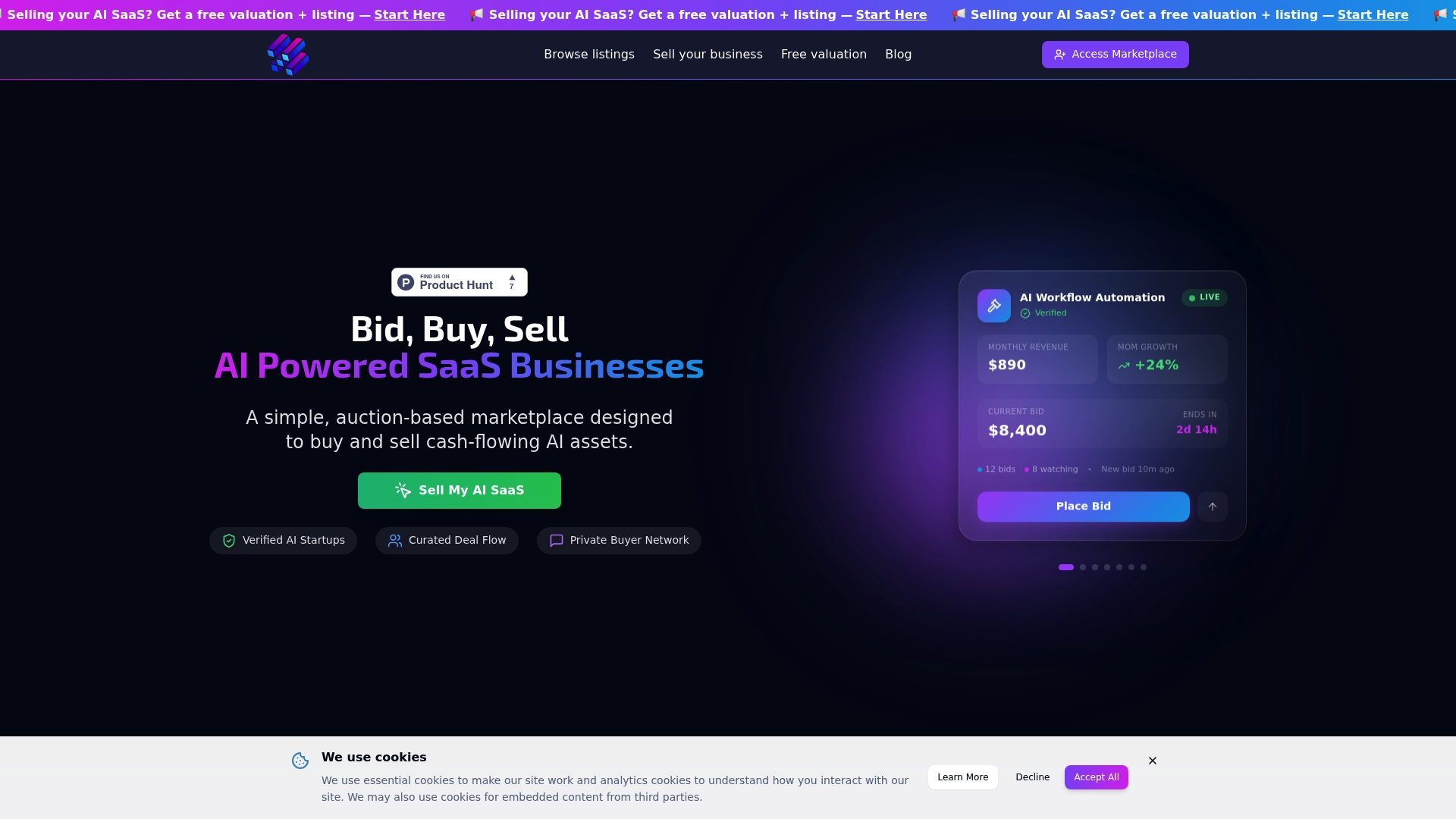
Every deal follows the same six stages, closes through Escrow.com with standardized contracts, and covers AI SaaS businesses only. If you are a seller, you can start a listing in the category that fits your product. If you want to read about the buying process first, our buyer’s guide to micro-SaaS is the place to start.
FAQ
What is micro PE deal sourcing?
It is the process of finding, contacting and qualifying small companies a micro private equity buyer or search fund could acquire. It includes outreach, relationships, intermediaries and marketplaces, plus the tracking that turns those into a pipeline of real conversations.
How much time should I spend on proprietary versus brokered deals?
Stanford’s search fund research describes a general consensus of about 80 percent proprietary and 20 percent intermediated. For micro-SaaS you can adjust it, but keep both channels running so one slow month in either does not stall the search.
How do search funds find micro-SaaS deals?
Mostly through direct contact with founders, particularly on Twitter and Indie Hackers where many share revenue publicly, along with referrals and listings. A marketplace for AI SaaS adds a source of founders who are already ready to sell.
How do I screen a micro-SaaS lead quickly?
Check it against a written buy box first, then look at revenue trend, churn, customer sources, technology dependencies and founder involvement. Drop leads that fail a negative criterion immediately, and keep a status and next action for the rest.
What does it cost to source deals on AIExchange.club?
Listing is free, and the success fee is a flat 10% paid only when a deal closes, with no monthly fees. Buyers who want full marketplace access can choose an optional membership at $49 per month or $399 per year.
AI SaaS businesses for sale right now
AI Business Broker | Helping AI SaaS founders secure confidential exits | 2.16M in AUM
Comments (0)
Be the first to share your thoughts.


