
An off-market SaaS deal is a private sale of a software business that is never publicly advertised. The seller talks to one buyer or a short list of buyers, under NDA, and the deal closes without an open listing or a public auction. It is a different thing from a SaaS “lifetime deal”, which is a discount offer on a subscription. If you came here for the second meaning, there is a short section on it below. The rest of this guide is for founders who want to sell quietly and buyers who want access to deals nobody else sees.
We run a marketplace for AI SaaS businesses, so we look at this from the AI SaaS side: small, revenue-generating products, often built by one or two people.
TL;DR
- An off-market SaaS deal is a private, confidential sale to a chosen buyer. A lifetime deal is a one-time-payment product discount. They are unrelated.
- Sellers go quiet to protect customers, staff and competitive information, and because broad processes can stall. Buyers go there for less competition.
- Value an off-market deal the way you would any other: on earnings or recurring revenue, not on secrecy. A private sale does not justify a discount or a premium.
- Skip no steps. LOI, due diligence, a written purchase agreement and escrow matter more when nobody else is watching.
- On AIExchange.club, listings are free, the success fee is a flat 10% with no monthly fees, and deals close through escrow with standardized contracts. The marketplace is for AI SaaS businesses.
What “off-market” means for a SaaS business
A business is on the market when it is publicly listed, advertised to a broad buyer pool, or put through an open auction. It is off-market when the owner negotiates privately. That can happen in three ways:
- The buyer approaches the founder directly, with no listing in existence.
- The seller approaches a short list of people they have chosen, such as a competitor, a partner or an adjacent product owner.
- A confidential channel introduces both sides, for example a private buyer network where listing details are shared only after an NDA.
The third route is the middle ground most small founders want. You get confidentiality without having to know a buyer personally.
Off-market is not a lifetime deal
The top search results for this phrase are mostly about lifetime deals, which is why the confusion matters. A lifetime deal is a one-time payment, usually $49 to $299, for permanent access to software at a fixed tier. “Lifetime” refers to the life of the product, not the customer. If the company shuts down or is acquired and sunsetted, access ends. The founder side carries its own risk: the seller takes on ongoing service costs for customers who paid once.
There is one link between the two topics. Heavy lifetime-deal cohorts show up in diligence. A buyer will ask how many customers hold lifetime plans, because they bring no recurring revenue but still cost money to serve. If you plan to sell, know that number before a buyer asks.
Why founders and buyers choose a private sale
Reasons on the seller side
The common motive is confidentiality. A public listing can tell customers, employees, suppliers and rivals that you are leaving. For a one-person AI product that risk is smaller than for a 40-person company, but it is real: a customer who hears that the founder is exiting may start looking at alternatives, and a competitor who sees your metrics learns what you charge and how you grow.
There is also a market reason. PitchBook reported in 2026 that software sellers were increasingly approaching a short list of buyers privately to avoid failed formal processes. The same report notes advisers seeing a gap between what sellers expect and what buyers will pay, partly because the effect of AI on a software business is hard to underwrite. That reporting covers larger software transactions, but the logic carries down to micro-SaaS: a deal that fails in public is hard to restart.

Reasons on the buyer side
Buyers want fewer competing bids and more time with the seller. In an open auction you are one of many bidders on a short clock. In a private conversation you can ask for a longer call, see the code earlier and structure the price, for instance with part of it deferred.
The tradeoff is sourcing. Nobody hands you off-market deals. You either do the outreach yourself or you join a channel where private deals are shared.
How buyers find off-market AI SaaS businesses
There are four practical routes.
Direct outreach. Founders publish revenue and growth openly in communities such as Indie Hackers, and some will talk about an acquisition if the offer is serious. A short, specific message works better than a template. Name the product, say what you would do with it and state your budget range.
Product directories and app stores. Look for products with steady usage, stale update history and a founder whose attention has clearly moved on. Those are the sellers most likely to say yes.
Your own network. Agency owners often know which tools their clients depend on and who built them. A tool you already use is a lower-risk acquisition because you know the product.
A private buyer network. This is the route we built a Private AI Acquisition Network for: buyers state what they want to acquire, and matching runs against listings that sellers have kept confidential behind an NDA. You can also browse what is currently public in the AI SaaS marketplace to calibrate what asking prices and revenue levels look like.
How sellers find buyers without broadcasting the sale
If you are the seller, the goal is to widen the pool of qualified buyers without widening the circle of people who know. A workable order:
- Get your numbers clean first. Twelve months of revenue by plan, churn, hosting and API costs, and what you personally spend your time on. A buyer who has to rebuild your books will lower the price or walk away.
- Get a valuation range. Our AI SaaS valuation quiz gives a data-backed estimate so you do not anchor on a number from a forum post.
- Decide what stays hidden. Early-stage teasers should be anonymous: category, revenue band, growth, tech stack. The name, domain and customer list wait until the NDA is signed.
- Require an NDA before any detail. Then share in stages: summary financials first, then analytics access, then code, then customer data last.
- Screen buyers for proof of funds and fit. Ask what they have acquired before, how they will pay and who will run the product afterward.
- Never skip the paperwork because the buyer feels friendly. A private sale still needs a signed agreement and a protected payment.
On AIExchange.club, listing is free, and listings can be protected by NDA so serious buyers see the detail while the public does not. If you would rather have a person handle the process, our Boutique AI M&A Advisory is the assisted option. It has no published price, so ask us for terms.
Pricing an off-market deal
Privacy does not change the arithmetic. Small SaaS businesses are generally priced on seller discretionary earnings (SDE): revenue minus cost of goods sold and operating expenses, plus the owner’s compensation. Larger or faster-growing products are often priced on a multiple of annual recurring revenue instead. Our guides cover both: SaaS valuation multiples by category, and SDE versus EBITDA for deciding which earnings measure applies to you.
A real data point helps with scale. One buyer who wrote up the purchase of a side project paid $128,000, or 3.5 times SDE. That is one transaction from an earlier period, not a market multiple, so treat it as an example of how the math is done and not as a benchmark.
A few factors move the multiple in any private sale:
- Revenue quality. Annual plans and low churn are worth more than monthly plans and high churn.
- Dependence on the founder. If support, sales and development all route through you, the buyer prices in the cost of replacing you.
- Platform and API risk. For AI products built on third-party models, price changes or deprecations from the model provider are a diligence item.
- Code and documentation. A product another developer can pick up in a week is easier to buy than one that lives in the founder’s head.
- Customer concentration. One customer at 40% of revenue is a risk, whatever the total.
If you are weighing a private negotiation against competitive bidding, read our comparison of auction versus private sale and the notes on auction strategy. A single buyer can pay a fair price, but only a competitive process proves what the market would have paid.
Due diligence when nobody else is looking
A private deal has one risk an open process partly offsets: fewer eyes. Nobody else is checking the claims, so the buyer has to. Build the review around four areas.
| Area | What to verify | Typical evidence |
|---|---|---|
| Revenue | Monthly recurring revenue, churn, refunds, lifetime-plan customers | Payment processor exports, bank statements |
| Customers | Contract terms, cancellation rights, concentration | Customer agreements, account list |
| Technology | Code quality, hosting, API and model dependencies, security | Repository access, architecture notes, uptime history |
| Legal | Ownership of code, domain and brand, third-party licenses | Assignment records, license list |
For AI products, add model dependency and data handling: which provider’s model does the product call, what happens if its pricing changes, and what user data is passed to it. Our guides on AI SaaS due diligence and a general due diligence checklist for buying a business walk through the requests in order.
Sellers should expect these requests and prepare for them. A seller who answers quickly and with documents keeps the price. One who answers slowly gets re-priced.
If the buyer plans to borrow, the cost of capital belongs in the model early. We cover that in how to finance a SaaS acquisition.
From first call to closing
The sequence is the same whether the deal came from a listing or a cold email. In the buyer-written account mentioned above, the steps were finding a business, negotiating an offer, signing an LOI, running due diligence, signing an asset purchase agreement and closing. Our pipeline follows that logic in six stages:
- Kickoff call. Both sides confirm scope, price range and timing.
- LOI. A short letter of intent sets price, structure and exclusivity.
- Due diligence. The buyer verifies revenue, code and contracts.
- APA or ATA. The asset or technology purchase agreement is drafted and signed.
- Escrow. The buyer funds escrow before assets move.
- Closing. Credentials, code, domain and accounts transfer and funds are released.
The purchase agreement is where a private deal is won or lost. An asset purchase agreement lists the purchased and excluded assets and the assumed and excluded liabilities, and transfers the purchased assets free of liens other than permitted ones. That filing is from a public company’s deal, much larger than a micro-SaaS sale, but the structure is the same one a small deal uses. Sellers can read our seller’s guide to the APA, and both sides can use the closing checklist and the step-by-step acquisition walkthrough.
Why escrow matters most in a private deal
When the buyer and seller found each other without any intermediary, each has a fear: the buyer that they will pay and receive nothing, the seller that they will hand over the product and not be paid. Escrow removes both. In the account above, the buyer funded Escrow.com first, the seller delivered the credentials and assets, and a three-day inspection period followed before funds were released with no red flag raised. Every deal on our platform closes through escrow with standardized contracts, signed in-platform, with funds held by Escrow.com. Our target close time is under 14 days.
Perspective
Most founders who ask about off-market deals are really asking for two things at once: privacy and a fair price. Those pull against each other. The more quietly you sell, the fewer buyers see the business.
Our view is that you should not have to pick. A confidential listing behind an NDA, matched against a private buyer network, gives you a narrow audience of people who are actually looking. And a structured pipeline with standardized contracts and escrow means the privacy does not cost you protection.
We also think the economics should be plain. Listing is free. The success fee is a flat 10%, paid only when a deal closes, with no monthly fees. Nothing about a founder’s exit should depend on paying for visibility first.
Phillip
Run your deal on AIExchange.club
If you are a founder of an AI SaaS business, list it for free. Our categories include automation, chatbots, content creation, customer support, data and analytics, developer tools, marketing tools and productivity. You pay a flat 10% success fee only if the deal closes, with no monthly fees.
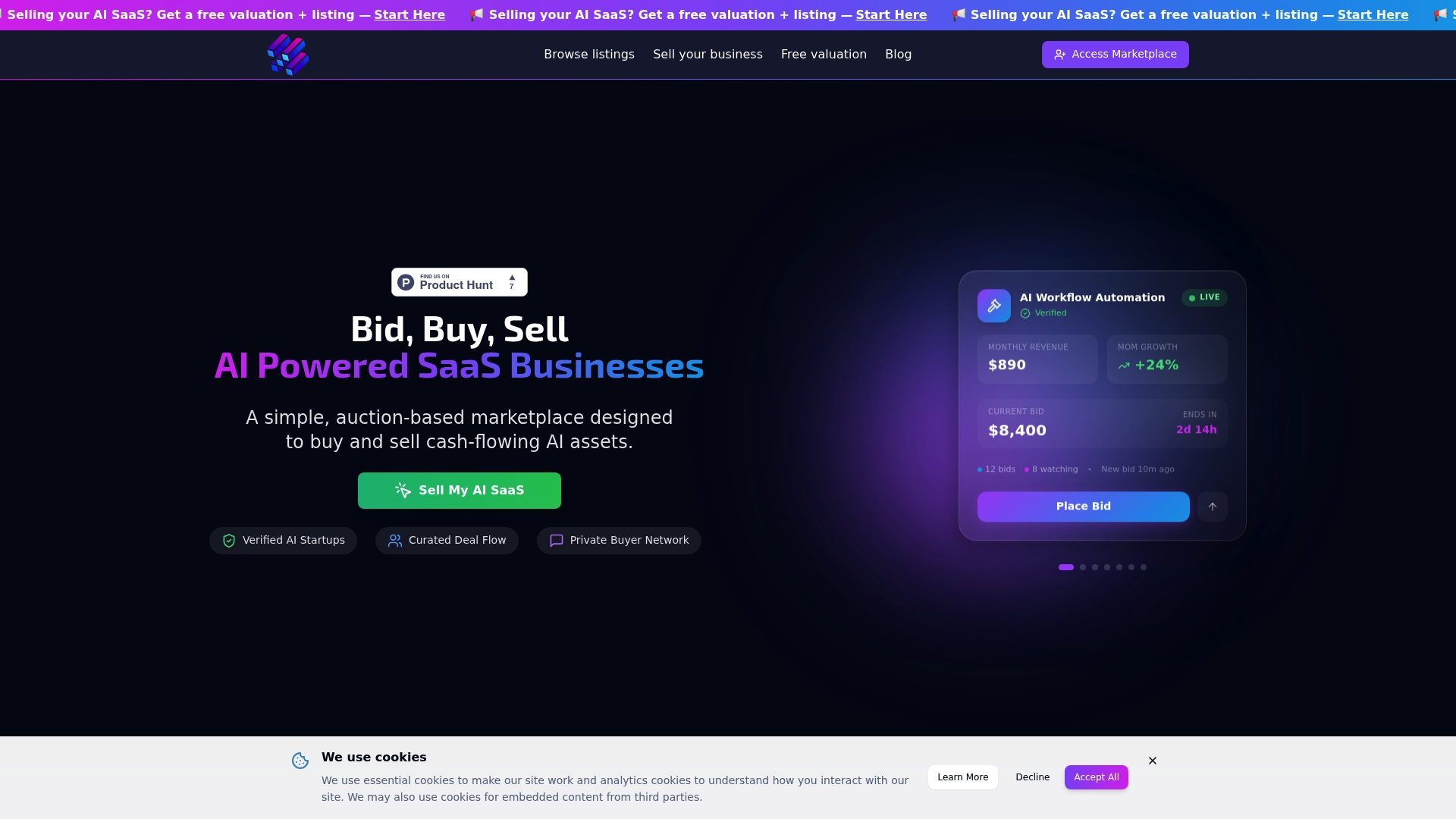
Buyers can join through Marketplace Membership, priced at $49 per month or $399 per year, for full marketplace access. The marketplace is for AI SaaS businesses, and every deal closes through escrow with standardized contracts.
FAQ
Is an off-market SaaS deal the same as a lifetime deal?
No. An off-market deal is a private sale of the whole business. A lifetime deal is a one-time payment for permanent access to a product, and “lifetime” means the life of the product, not the buyer. The two only meet in diligence, where lifetime-plan customers count against recurring revenue.
Do I get a lower price by selling privately?
Not automatically. Price follows earnings, growth, churn and risk, not the sales channel. A private sale can cut the cost and disruption of a long process, but with only one bidder you have less evidence of what the market would pay. Get a valuation range first, and compare more than one buyer if you can.
How do I keep a sale confidential?
Share in stages. Start with an anonymous summary, require a signed NDA before sharing the name or financials, and open code and customer data last. On AIExchange.club, listings can be protected by NDA, so details reach only buyers who have agreed to it.
What does it cost to sell on AIExchange.club?
Listing is free. The success fee is a flat 10%, paid only when a deal closes, with no monthly fees, no subscriptions for sellers and no upsells. Deals close through escrow with standardized contracts.
Can I buy without a broker?
Yes. Buyers can browse, make offers or join live auctions on the marketplace, and the six-stage pipeline guides both sides to closing. Our Boutique AI M&A Advisory is available if you want assisted support instead.
Sources
- What Is a Lifetime Deal? A Complete Beginner’s Guide (2026)
- SaaS Lifetime Deals: Buyer Risks and Founder Math
- Software dealmakers turn to back-room negotiations (PitchBook)
- What it’s like buying a side project for $128k (TrialToPaid)
- Asset purchase agreement exhibit filed with the SEC
Recommended
AI SaaS businesses for sale right now
AI Business Broker | Helping AI SaaS founders secure confidential exits | 2.16M in AUM
Comments (0)
Be the first to share your thoughts.


