
For most AI SaaS founders and first-time acquirers, a facilitated marketplace is the better route. Listing is free. The cost is a flat 10% success fee with no monthly fees. Deals close through escrow with standardized contracts. A traditional broker is built for larger, bespoke sales. A marketplace fits the typical AI wrapper, agent or micro-SaaS, where revenue is real but the deal is too small to justify a retainer or a six-figure minimum. At AI Exchange Club, a marketplace for AI SaaS businesses, every deal runs through a structured pipeline so the sale is not left to the two parties to improvise.

TL;DR
- A broker is a person who runs your sale. A marketplace is a platform where buyers find your listing. Facilitated marketplaces now add process to that platform, so the gap is narrower than it was.
- On AI Exchange Club, listings are free, the success fee is a flat 10% with no monthly fees, and it is paid only when a deal closes.
- Deals close through escrow with standardized contracts, in a six-stage pipeline with a target close time under 14 days.
- Choose a marketplace for micro-SaaS, AI wrappers and side projects. Choose assisted advisory when the business is larger or the sale is complex.
- Whichever route you take, due diligence and a sound closing structure matter more than the channel.
What the two routes actually are
A broker is an intermediary hired to run your sale. The broker prepares the listing materials, finds and screens buyers, coordinates negotiation and manages the process through closing. You pay for that labor, usually as a percentage of the sale price, and often with some form of commitment up front.
A marketplace is a platform where sellers publish listings and buyers browse them. In the plain version, you write the listing, answer buyer questions and negotiate yourself. The platform provides exposure, and little else.
That plain version is the one many founders have in mind when they compare the two. It is also why they assume a marketplace means doing everything alone. A facilitated marketplace changes that. AI Exchange Club runs each deal through six stages: Kickoff Call, LOI, Due Diligence, APA/ATA, Escrow and Closing. The LOI is a letter of intent, the non-binding document that sets the headline terms. The APA/ATA is the asset or technology purchase agreement, the contract that actually transfers the business. Legal documents are generated and signed in-platform through DocuSeal, and funds are held by Escrow.com, a licensed third party that holds payment until everyone fulfills their side of the transaction.

So the real question is not “do I want help or not.” It is how much human labor your deal needs, and what you are willing to pay for it.
Broker vs. marketplace: side by side
The table compares a conventional broker with AI Exchange Club’s marketplace on the points that decide most AI SaaS sales.
| Factor | Conventional broker | AI Exchange Club marketplace |
|---|---|---|
| Who runs the process | A person assigned to your deal | A structured six-stage pipeline, with assisted options |
| Listing cost | Terms set by each broker | Free listing |
| Fee | Set by each broker | Flat 10% success fee, paid only when a deal closes |
| Monthly fees | Varies by broker | None |
| Contracts | Often drafted per deal | Standardized, signed in-platform via DocuSeal |
| Payment protection | Depends on the broker | Funds held by Escrow.com |
| Target close time | Set by the deal | Under 14 days |
| Confidentiality | Teasers and NDAs | Confidential listing protection via NDA |
| Best fit | Larger, complex or bespoke sales | AI SaaS from side projects to funded products |
The fee line matters most to small sellers. A percentage fee scales with the sale, which is fair on a large deal. On a sale in the tens of thousands of dollars, a minimum retainer or a minimum fee floor can eat a much bigger share of the proceeds. A flat 10% with nothing owed before closing keeps your cost tied to the outcome and nothing else.
How it works for a seller
A broker-led sale usually starts with an engagement: you sign terms, hand over financials and wait while the broker prepares materials. The advantage is that someone else does the preparing. The cost is time before you even go live, and a fee structure you commit to before you know whether a buyer exists.
On a marketplace, you list first and talk later. At AI Exchange Club, listing is free, and you can run the free AI SaaS valuation quiz first to see where your business is likely to land before you decide on a price. Confidential listing protection through an NDA means buyers sign before seeing details you would not want a competitor to read.
From there, the sale can go two ways. You can accept an offer, or you can run a live auction. If you are unsure which suits your product, auction vs. private sale for an AI SaaS business walks through the trade-off, and how marketplace auctions work for AI SaaS covers the mechanics. Auctions suit products where several buyers are likely to want the same asset. A direct offer suits products with a clear niche and an obvious buyer.
Once you accept, the pipeline takes over:
- Kickoff Call. Both sides confirm what is being sold: code, domain, customers, accounts and any third-party dependencies such as model API keys.
- LOI. Price, structure and timeline are written down.
- Due Diligence. The buyer verifies revenue and code quality.
- APA/ATA. The purchase agreement is generated and signed in-platform.
- Escrow. The buyer funds the deal and the money sits with Escrow.com.
- Closing. Assets transfer, and funds are released.
The point of a fixed sequence is that neither side has to invent a process or argue about what comes next. That is most of what a first-time seller is paying a broker to provide, delivered here as part of the 10%.
If you want the full seller math, how to sell a SaaS business: what it costs and nets breaks down proceeds. And if the business is not yet ready, the 12-month checklist for preparing a business for sale is the place to start.
How it works for a buyer
Buyers care about two things: access to good deals, and not getting burned.
On access, a plain marketplace puts everything in one feed, and you sort it yourself. A broker, by contrast, tends to hand a buyer a short list. Facilitated marketplaces try to give you both. At AI Exchange Club, you can browse the live marketplace of AI SaaS businesses, submit offers or join live auctions. AI-driven deal matching, with notifications through the Slack community, tells you when something fits what you buy. The Private AI Acquisition Network is built for targeted matching, so you are not scrolling through categories that do not interest you. Listings cover AI writing tools, image and video generators, agents, chatbots, analytics, SEO tools, coding tools, customer support and many other AI SaaS categories.
On protection, the buyer’s risk is paying for something that is not what the listing said. Escrow addresses the payment half: funds are held until the transaction is fulfilled. Revenue and code quality verification addresses the other half. Standardized contracts mean you are not negotiating boilerplate from scratch on a deal that may be worth less than the legal bill.
Buyer access to the full marketplace is through an optional membership: $49 per month or $399 per year. Success fees are a separate matter, and the 10% applies only when a deal closes. If you are a first-time acquirer working with a small budget, how to finance a SaaS acquisition shows the real numbers.

Which route fits which deal
Size and complexity decide this more than anything else.
Pick the marketplace when:
- The product is an AI wrapper, a GPT-powered tool, a Chrome extension, a vertical AI SaaS or a side project with revenue.
- You are a solo founder who wants out without a drawn-out engagement.
- You are a buyer under $50k, a micro-PE fund or search fund under $100k, an agency owner buying a tool for clients, or an indie hacker buying your first asset.
- You want your cost tied to a closed deal, with nothing owed before.
- You want speed. The target close time is under 14 days.
Pick assisted advisory when:
- The business has a team, enterprise contracts, investor cap-table issues or a custom deal structure.
- You want a person to run the outreach and negotiation end to end.
That second case is covered too. Boutique AI M&A Advisory is the client’s assisted route, for sellers who want hands-on support. It has no published price, so ask what it costs on that page. The choice is not between a marketplace and leaving the platform: you can move between self-serve and assisted closing under one roof. For more on where experienced intermediaries add value in AI SaaS, see how brokers drive success in AI SaaS deals. If you are weighing a fully self-run sale, how to sell a business without a broker covers it for AI SaaS.
What does not change: diligence and tax
The channel does not remove the work that decides whether a deal is good. Three items matter on any AI SaaS sale.
Revenue and code. A buyer should verify that revenue is real, recurring and not dependent on one promotion, and that the code and accounts transfer cleanly. Pay particular attention to AI-specific items: who owns the prompts and fine-tuned assets, what happens to model API accounts on transfer, and whether usage costs leave margin at current pricing. AI SaaS due diligence: what to verify before you buy lists them, and the due diligence checklist for buying a SaaS or app business covers the general legal and financial side: corporate records, contracts and assignment rights, contractor classification, IP ownership, open-source licenses and data obligations.
Tax reporting. In the United States, when a purchase of assets makes up a trade or business, both buyer and seller generally report how the price was allocated across asset classes on Form 8594. The IRS instructions for Form 8594 explain which transactions it covers and how the allocation works. Because the APA/ATA is an asset purchase agreement, the allocation is worth settling with your accountant before you sign, not after.
Closing mechanics. Escrow protects both sides: the seller knows the money exists, the buyer knows it is not released until the deal is fulfilled. The M&A closing checklist for SaaS deals covers the transfer items to confirm on closing day.
Perspective
We built this around a simple observation: the typical AI SaaS sale is small, the founder is often a single person, and the traditional cost structure was never designed for them.
A side project earning a few thousand dollars a month does not need a retainer, a six-month engagement or a minimum deal size. It needs three things: a buyer who is serious, a contract that is not improvised, and money that is safe until the product changes hands. That is why every deal on AI Exchange Club moves through the same six stages, with standardized contracts signed in-platform and funds held in escrow.
The fee is flat 10%, paid only at closing, with no monthly fees and free listings. We would rather your cost be zero when nothing sells than collect from you while you wait.
The old dividing line was brokers for serious deals and marketplaces for everything else. We think a well-run marketplace, with an advisory option for the complicated cases, closes that gap for AI SaaS.
Phillip
Ready to list or buy
If you are selling, start with a free listing. Listings on AI Exchange Club are free, the success fee is a flat 10% with no monthly fees, and the deal closes through escrow with standardized contracts. Pick the category that matches your product, from chatbots and content creation to developer tools and customer support, and the marketplace for AI SaaS businesses takes it from there.
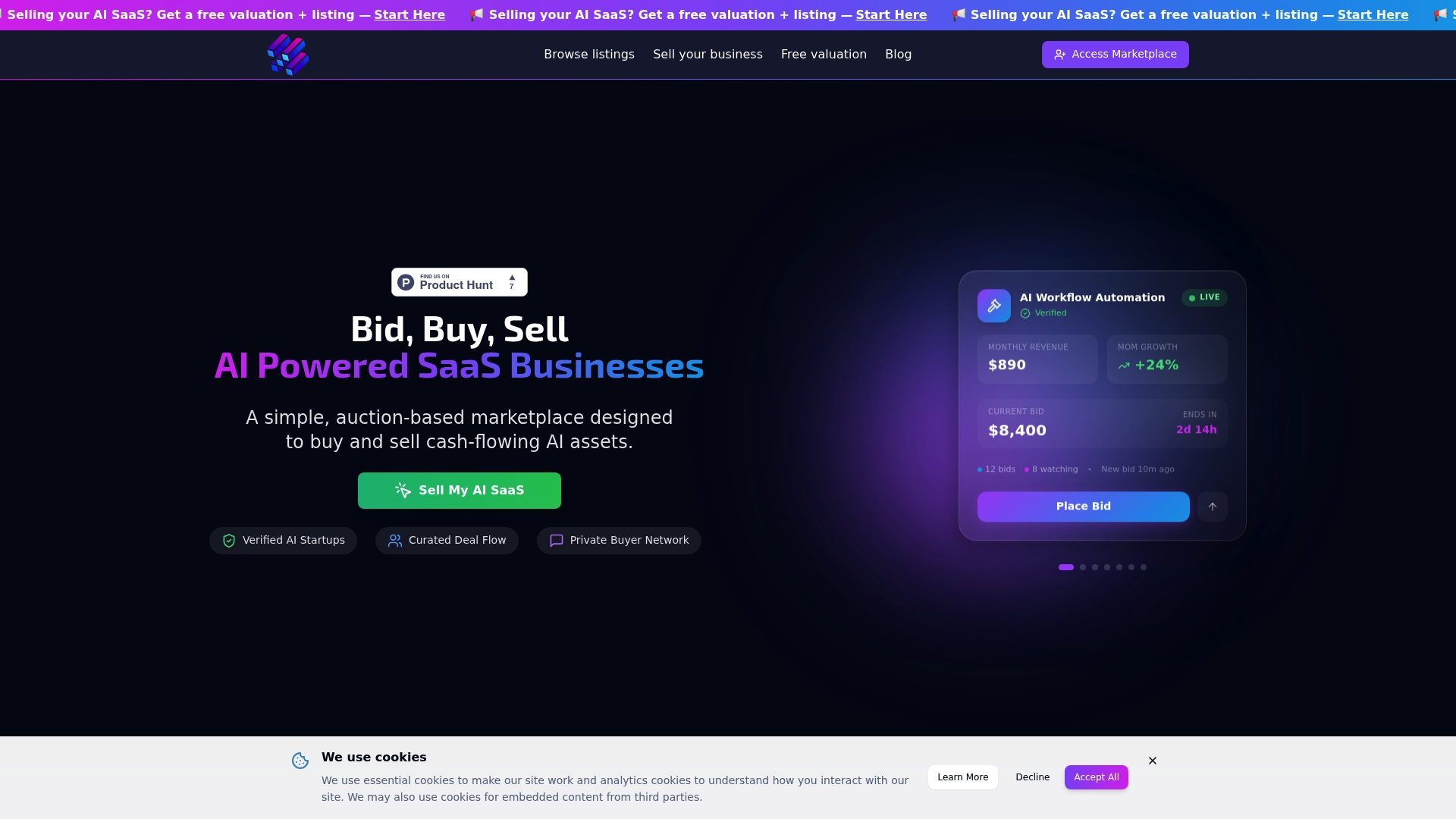
If you are buying, see the membership options: $49 per month or $399 per year for marketplace access. If you are not sure what your product is worth, the free valuation quiz comes first.
FAQ
Is a marketplace cheaper than a broker for an AI SaaS sale?
On AI Exchange Club, listing is free and the success fee is a flat 10%, paid only when a deal closes, with no monthly fees. Nothing is owed if the business does not sell. Broker terms are set by each broker, so compare the full cost, including any retainer, before you commit.
Is a marketplace safe for a seller who wants to keep the sale confidential?
Confidential listing protection through an NDA is part of how listings work on AI Exchange Club. Buyers agree to confidentiality before seeing sensitive details. Payment is protected too: deals close through escrow with standardized contracts, and funds are held by Escrow.com until the transaction is fulfilled.
How fast can a deal close?
The target close time is under 14 days. The six-stage pipeline, in-platform signing and escrow are designed to remove the delays that come from drafting contracts and arranging payment from scratch. Actual timing depends on how quickly due diligence is completed on both sides.
Can a marketplace handle a bigger or more complex AI SaaS deal?
Yes, through assisted options. Boutique AI M&A Advisory is available for sellers who want hands-on support, and the marketplace itself is for AI SaaS businesses ranging from vibe-coded side projects to fully developed products. Both routes use escrow and standardized contracts.
What does a buyer need to join?
Buyers browse the marketplace and submit offers or join live auctions. Full marketplace access is through an optional membership of $49 per month or $399 per year. The 10% success fee applies only when a deal closes.
AI SaaS businesses for sale right now

AI Business Broker | Helping AI SaaS founders secure confidential exits | 2.16M in AUM
Comments (0)
Be the first to share your thoughts.


